 Jordan2
 Kilimanjaro9
 Morocco4
 Uganda4
 United Arab Emirates3
 Argentina3
 Chile2
 Cuba2
 Ecuador3
 Guyana2
 Peru12
 Bhutan4
 Indonesia3
 Ladakh4
 Nepal12
 Pakistan1
 France2
 Georgia3
 Greenland2
 Norway2
 Svalbard4
 Trekking
 Summits
 Arctic
 Winter
 Kayaking
 Multi-activity
 Safaris
 Ultimate
 Kandoo Lite
Ecuador Volcanic Adventures
- 10days
- Challenging
- 5,897 mhighest point
- 3,755 mtotal ascent
- 164 kgCO₂, offset
 © Adobe Stock
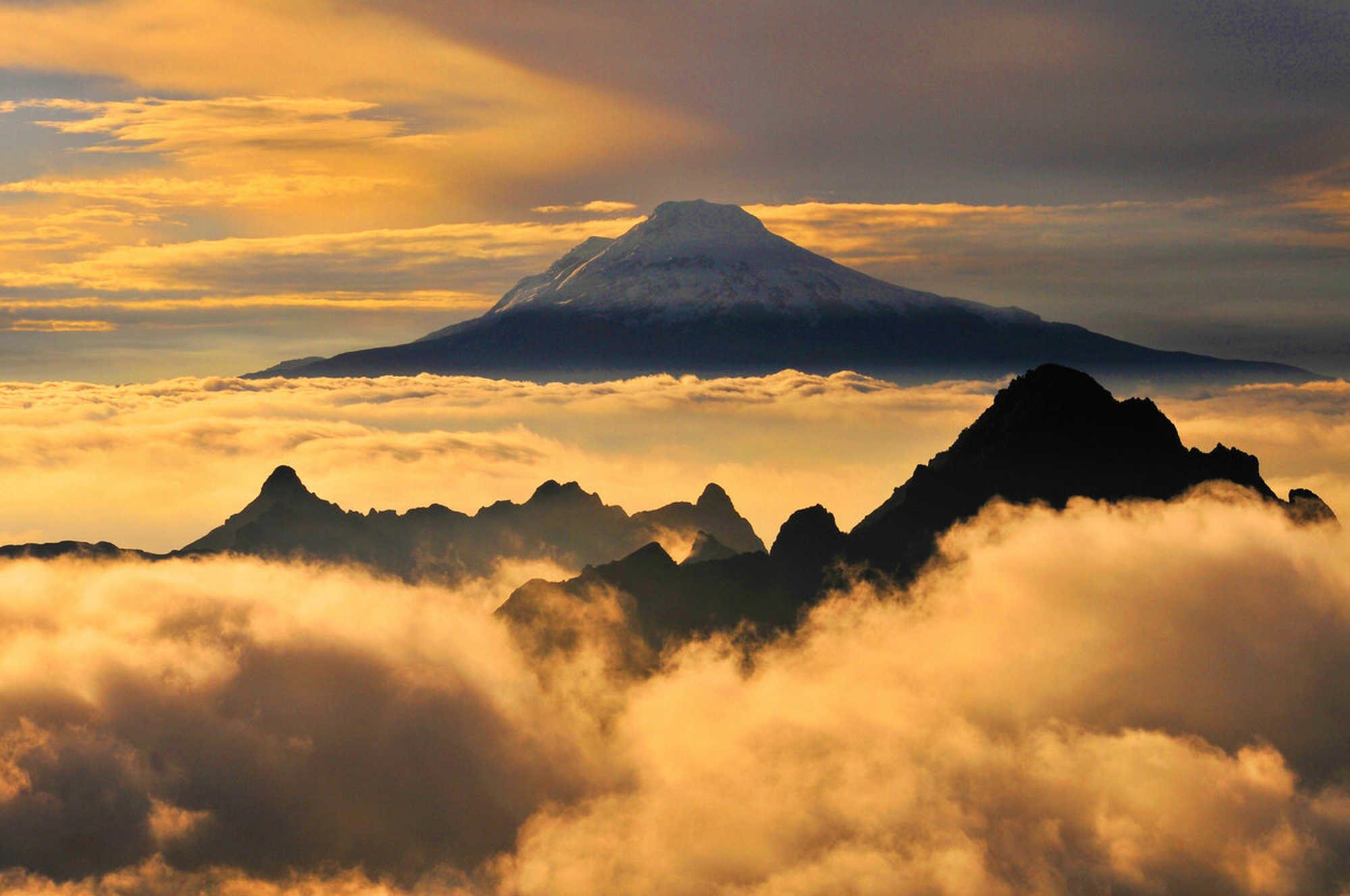
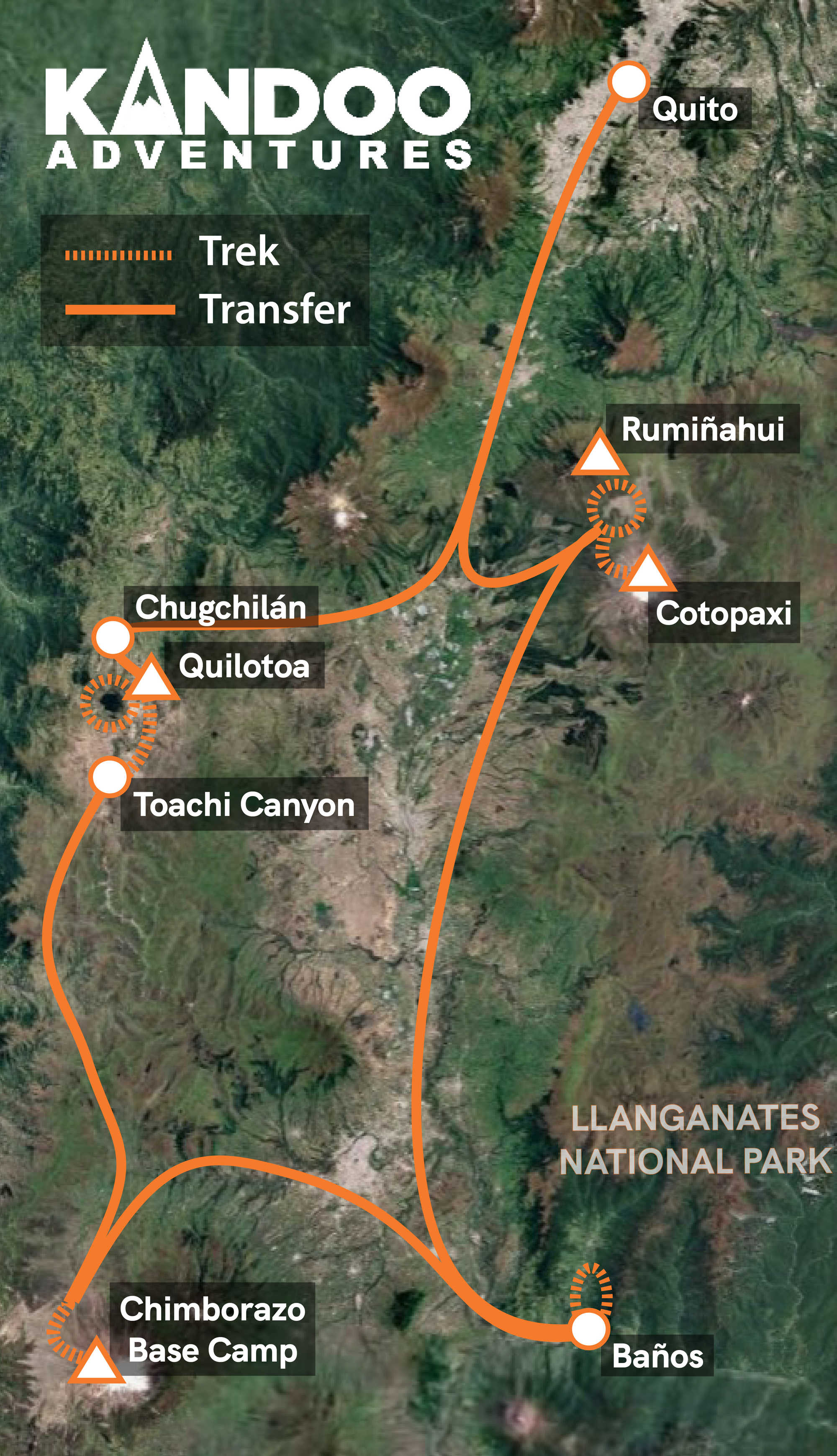
Trek through the volcanic highlights of the rugged Ecuadorian landscape, culminating in the perfectly conical shaped Cotopaxi, the highest volcano in the world, standing at 5897m! This 10 day adventure takes us from the deep blue hues of the Quilotoa Crater, to the rust coloured, lower slopes of Chimborazo, embracing the vibrant sights and sounds of Baños and pushing hard to Cotopaxi's icy crater. An adventure of a lifetime, experiencing a side of Ecuador that many don't get to see.
Trip highlights
- Reach the challenging summit of Cotopaxi (5897m)
- Trek around the beautiful, azure waters of Quilotoa Crater Lake
- Trek to the base camp of Ecuador's highest mountain - Chimborazo
- Trip fully carbon offset as standard
- Generally, 8 hours walking, but can up to 16 hours on summit day.
- Up to 1500m daily ascent or 2000m descent.
- Total altitude of up to 6500m.
You should have a high level of fitness and participate in endurance training to prepare for your trip.
10 days, day by day
The line is each day's high point. Flat steps are the rest and acclimatisation days that keep you safe up high.
Welcome to Quito! Declared a UNESCO World Heritage Site in 1978, the city is considered the cultural capital of South America and is located on the equator in a valley at the foothills of the Pichincha volcano. Depending on our arrival time, we can spend today exploring the old town of Quito and the surrounding area. In the evening, one of our trip leaders will meet us at the hotel’s lobby for a welcome briefing at 6pm. This is a time to ask any questions we may have regarding our upcoming adventure.
- Hotel
- Private transfer
Explore a truly unique experience in the heart of Quito city and discover it's history from the eyes of the locals, walking around it's narrow streets and visiting the iconic, architectural buildings of the Golden Church, San Francisco Square and the Main Square. We then attend Luis´ local workshop “Cruz Verde”. Luis is a well know artisan whose family has prepared the local candy “Colaciones” for the last 100 years, keeping alive Quito´s timeless tradition. For lunch, we will have the opportunity to sit with the locals and enjoy a tasty meal, freshly prepared using local products and flavours.
- Hotel
- Breakfast
The mountainous Andean landscapes provide inspiration today as we head out on a trek along the steep sided Toachi canyon. With stunning vistas of the small villages dotted along the riverside and indigenous people working in the fields, we are well and truly thrown into the depths of rural Ecuador. We hike down the canyon alongside the Toachi River until we reach the road that will take us to Chugchilán, a small town located in the middle of the Quilotoa loop. Here we will find our accommodation for the evening, a quaint eco-house nestled in the countryside. We have some time to explore the village and meet the friendly locals before dinner.
- 4 hours walking
- 160 m up
- Guesthouse
- Breakfast / Lunch / Dinner
Early this morning, after breakfast, we begin our hiking adventure on small trails carved out by locals to transport goods across the canyons to reach neighbouring communities. While trekking on this trail, it is common to see residents of the area bartering with one another, a traditional that is still holding strong. We venture down into impressive narrows canyons, then climb up to the top of the crater rim, where we are rewarded with spectacular views of Quilotoa Lake. The majestic beauty of this place is arresting. We enjoy a very scenic picnic with views from the volcano, out across the surrounding rolling landscape, before hopping into our vehicle and transferring to our hacienda in the foothills of Chimborazo volcano.
- 4 hours walking
- 760 m up
- Guesthouse
- Breakfast / Lunch / Dinner
At midnight, we will get up and have a snack to give us some energy before starting our climb. We will set off traversing the ochre coloured scree slopes to reach the glacier where we will be roped together to stay safe as we cross snow bridges and climb steep sections. From the summit we have a marvellous view of the icy rim of Cotopaxi's crater, with an 800m diameter, this cavernous basin boasts breathtaking views of the surrounding volcanoes and peaks. Returning to the refuge around midday, we have some lunch before being transferred back to Quito.
- 9 - 11 hours walking
- 1,035 m up
- Hotel
- Breakfast / Lunch
Pick your departure
Small groups that run once a few people book, and guaranteed dates that run whatever happens.
- 2 Jan – 11 Jan 2027Saturday startOpen for bookings£1,999save £100Book this date
- 6 Feb – 15 Feb 2027Saturday startOpen for bookings£1,999save £100Book this date
- 5 Jun – 14 Jun 2027Saturday startOpen for bookings£1,999save £100Book this date
- 17 Jul – 26 Jul 2027Saturday startGuaranteed£1,999save £100Book this date
- 14 Aug – 23 Aug 2027Saturday startOpen for bookings£1,999save £100Book this date
- 4 Sept – 13 Sept 2027Saturday startOpen for bookings£1,999save £100Book this date
Prices per person sharing. “2 more to confirm” means the date runs once two more people book; guaranteed dates run whatever the group size.
- Airport transfers
- Pre and post trip accommodation in Quito
- English speaking local guide for duration of the trip
- Qualified mountain guides on a 1:2 ratio for Cotopaxi climb
- All luggage transfers between accommodations
- All meals stated on itinerary
- Filtered water available
- All land transfers in private vehicles
- International flights and visas
- Travel insurance- including altitudes up to 6000m
- Meals not mentioned on itinerary
- Drinks and personal expenses
- Extra optional activities not included in itinerary
- Tips for your guide
 Route map
On the trail
Before you go
Difficulty, food, rooms, kit, money, visas and health, straight from the trip dossier.
Download trip dossierThis trip is given a challenging rating because it has some fairly tough elements incorporated into it. Cotopaxi is the most accessible and therefore most popular peak to summit in Ecuador, however this is not to say its an easy ride. You will be walking on glacial terrain, crossing snow bridges and moving between crevasses which makes this a proper challenge! Sitting at 5897m above sea level, you will also feel the effects of altitude at this height. However, for those who have already completed a high altitude peak such as Kilimanjaro, this trip provides an excellent challenge to try out your first attempt at winter mountaineering in a similar environment.
Although this programme does not require any technical climbing ability or experience, you should be in the best physical condition possible before departure. To prepare we would recommend spending lots of time out in the mountains on uneven and steep terrain, getting your leg muscles used to long, strenuous days. You will be hiking for multiple consecutive days and taking in significant ascents on some of these days, with 30 degree+ slope gradients, so it is important that your body is prepared for this. It is also worth noting that, as with all physically demanding challenges, mental stamina is the most important thing, so make sure to train this too.
Take a look at our Ecuador Training Guide for tips on how to prepare for your climb.
If you have any questions about your suitability please do not hesitate to contact us.
In Ecuador, expect to try a whole host of exotic foods and spices as we travel through various different regions. From the traditional foods of toasted corn and stuffed meats, to the more trendy spicy empanadas and citrus-infused cerviche the cuisine here is delicious! The guesthouses and smaller hotels we stay in will provide hearty, generous meals and in the larger cities you will have the choice of local restaurants or hotel favourites. Drinks are not included with dinner, so please make sure you have some cash with you for any drinks you may want. Please also be aware that hotels in small villages and town may not accept card payments.
In the smaller hotels, breakfasts will generally consist of a selection of fruit, bread, eggs, spreads and yoghurt. Packed lunches will be provided by the hotel or guesthouse and will range from rice and beans to sandwiches, fruit and pastries. You will carry your lunch items with you in your daysack. Remember to bring your favourite snacks (cereal or energy bars, dried fruits, chocolate) with you to keep you going through the day.
Water in Ecuador isn't necessarily safe to drink. We provide water bottle refills every morning and evening from a filtered water source, if you think you will need to refill your bottle during the day, we suggest you bring a water purification system. We do not encourage the purchase of single use plastic bottles so we would recommend either a charcoal filter or purification tablets to make your water safe to drink.
Your full day by day itinerary shows what is included in terms of accommodation and meal basis. All of our pre- and post- climb accommodation is based in Quito. Where your hotel basis is B&B, you can usually purchase snacks or meals at the hotel, which can be paid in US Dollars. When you arrive at the hotel, take a moment to familiarise yourself with the layout and the procedures in the event of a fire, especially your escape routes and fire exits.
On this trip we will stay in a range of accommodation. For some of the nights in the valleys between mountain days we will be staying in family run guesthouses, know locally as Hosteria. These are small, simple hotels with basic twin or double rooms. Most of the guesthouses we use have en-suite rooms however, dependant on the location, some have shared bathrooms. In Quito, we will be staying in a comfortable 4* hotel in en-suite rooms on a twin share basis. Single rooms are also available on request for all nights on this trip.
You will have an English speaking local guide with you for the duration of your trip to Ecuador. They will be joined by qualified, experienced mountain guides for your Cotopaxi summit attempt. On summit night, you will have a 1:2 guide to client ratio.
On this trip you have a maximum luggage allowance of 2 x 23kg bags. We recommend using soft 80-100L duffel bags.
Your bags will be transported by vehicle between locations, and you will carry a smaller 30-40L daysack on your treks each day.
Please do not book your international flight until you have confirmation from Kandoo staff that your booking is guaranteed.
You will need to fly into Mariscal Sucre International Airport (UIO) in Quito on Day 1 of your trip.
For US travellers, there are direct flights to Mariscal Sucre airport with American Airlines, LATAM and Delta from Miami and Atlanta. They also offer services from other main hubs such as New York, San Francisco and Dallas, via Miami. Copa Airlines also offer a service to Quito via Panama from San Francisco and Los Angeles.
From the UK, Delta offer flights from London Heathrow via Atlanta (ATL) and Iberia and British Airways have flights via Madrid (MAD) from all London airports. For UK guests who live further north, KLM have flights via Amsterdam (AMS) from Manchester, Glasgow, Birmingham and other main hubs.
Upon arrival at the airport, once you have exited the Arrivals area, keep an eye out for one of our team who will be waiting to meet you. Your hotel is around a 50 minute drive from the airport.
Travelling Responsibly
Here at Kandoo, we like to support our guests to make their travel more sustainable. As of 2025, we are offsetting the carbon on all of our trips from arrival in destination to dropping you back off at the airport. As we don't include flight travel in our trips these aren't included in our offsetting calculations, so we are providing you with the calculator below for you to do this yourselves.
eC02 Flights Calculator
It is a requirement of joining any of our trips that you attend a pre-trek briefing the evening before the trip begins. This gives our guide team the opportunity to review the plans for the trip with you, make sure you have all the right gear and answer any questions you may have. The briefing in Quito is held the at 6pm the evening before the trip begins in the hotel lobby. Should you arrive on a late flight, you will have your briefing on the morning of Day 2.
The main currency in Ecuador is the US Dollar (USD). These can be easily exchanged before travelling. It is very important that US bills be new (no more than 10 years old), crisp and untorn. You will also be able to exchange money upon arrival in Quito. Most hotels, banks and exchange bureaus will exchange money for you and our guides are happy to assist you to do this. Please note that whilst you are out of the big cities there won't be anywhere for you to exchange money, so we would recommend doing this before leaving Quito. Credit cards are accepted in most restaurants and shops in the cities however in the smaller towns and villages they will be useless, so please make sure to have some cash on you as well. If you are relying on a credit or debit card for emergency funds, make sure you tell your card issuer that you will be using it abroad, or you may find that it won't work when you really need it.
Depending on how many souvenirs you want to buy, we would suggest a recommended budget of US$200 to $250, in addition to your tips.
Tipping is typically not expected in Ecuador, but is appreciated. The amount you tip should be based on the level of service you feel you have received and is completely voluntary. In restaurants and bars there is an official 10% service tax. For your trip crew, the decision on how much to tip should be determined by how well they serve you whilst you are on your adventure but the amounts below are a recommendation:
Guides: US$10 – 20 per trekker per day
Drivers: US$5 – 10 per trekker per day
Specialist mountain guides: US$50 per person per climb
Specialist mountain guides will join you for the climbs. Any tip made to them should be made after your climb as you will leave them after the climb has ended.
Tips should be made in US Dollars and bills should be crisp, untorn and less than 10 years old.
Most travellers require a passport that is valid for at least six months after the return date. It is your responsibility to confirm your specific passport requirements and please be aware that proof of onwards travel may be required. You can check your requirements on the website provided by the Ecuadorian government.
United States and UK passport holders do not require a visa to enter Ecuador. On arrival you will be granted a maximum 90 day stay in the country. This information may be subject to change, without notice, by the local authorities. It is your responsibility to check the latest travel requirements and information before departure.
The World Health Organisation recommend the following vaccinations for travel to Ecuador:
Tetanus
Hepatitis A
Hepatitis B
Diphtheria
Typhoid
Rabies
Yellow Fever - This is necessary for all citizens of Peru, Bolivia, Columbia and Brazil and for any guests who have spent 10+ days in these countries prior to their Ecuador trip. It is also necessary if travelling from a country with Yellow Fever or transiting through one for 12+ hours.
If you are joining our Yasuni and Waorani extension in the Amazon rainforest, it is strongly recommended that you are vaccinated against Yellow Fever.
It is your responsibility to check the latest health information before travelling.
Before you can join any Kandoo Adventures trek, you will need to insure yourself against accident, injury, and illness. Your insurance must cover the cost of rescue and repatriation if necessary. Make sure your insurer knows of your travel plans, and verify that your policy fully covers your trek and any other activities you will participate in. Specifically, for our Peaks of Ecuador trip, you need to be covered for trekking up to 6500m and for our Volcanic Adventures trip you need to be covered for trekking up to 6000m. It is your responsibility to ensure that you are fully and adequately insured for the duration of your trip. Please ensure that all activities, excursions and destinations in your itinerary are included in your travel insurance policy, in addition to your regular cover for cancellation and medical expenses.
We ask that you keep a copy of your policy summary (containing policy number and the emergency contact number for your insurer) in your day sack at all times, so that we can access this information should we need to contact the insurer on your behalf. You will also need to bring details of your insurance cover to the pre-trek briefing.
Malaria
There is low to no risk of malaria in any of the regions we operate in Ecuador. When the risk is low to none, antimalarials are not normally advised.
Your guide will carry a group first aid kit, however you will also need a personal first aid kit to include - tape, antiseptic wipes, assorted plasters, wound dressings, lip balm, re-hydration sachets, blister dressings, antihistamines, pain killers, Vaseline.
For this trip you will need specialist climbing equipment. We provide the following equipment as part of your trip package. This equipment is regularly checked and updated to meet regulations.
Ropes
Ice Axe
Crampons
Helmet
Harness
2 x locking carabiners
Please note: we do not provide stiff boots (B2 or B3) for this trip so you will need to bring your own
As well as climbing kit, we also provide you with:
Husky sleeping bag - rated to -20 degrees
Black Diamond trekking poles
HEADGEAR
Warm beanie style hat – knitted or fleece
Neck gaiter or scarf. It can get very cold in the upper reaches of the volcanoes. A scarf or balaclava comes in useful as a warm layer for your neck and face!
Sun hat – preferably wide-brimmed for protection
Sunglasses – high UV protection
Headlamp (plus extra batteries)
Ski goggles - to protect against spindrift in high winds
Swimming cap – mandatory for hot springs in Baños
UPPER BODY
Thermal or fleece base layer
Long sleeve shirt/tshirts – light or medium weight, sun shirts work well
Short sleeved shirt/tshirts – lightweight, moisture wicking
Fleece or soft shell jacket
Thin insulated jacket/midlayer
Thick insulated jacket – down or primaloft
Water/windproof hard shell outer jacket
Gloves – lightweight, fleece or quick drying fabric
Gloves – heavyweight, insulated, preferably water resistant
Over mittens – with safety straps
Swimming costume - for hot springs
LEGS
Leggings – thermal or fleece base layer
Trekking trousers – light or medium weight – convertible trousers work well
Waterproof hard shell trousers
Gaiters
FEET
Climbing boot – insulated, stiff-soled (B2 or B3)
Trekking boots – with good ankle support
Training shoe or similar – to wear in the evenings
Mid-weight trekking socks
Breathable, high-wicking liner socks
Thermal trekking socks for upper reaches of your Cotopaxi climb
TREKKING GEAR
Small Rucksack or Daypack (30-40 litres) to carry water and personal items
Water bottle or hydration bag – must be able to carry 1.5-2L of water
Water purification system - a charcoal filter or chlorine tablets will work well
CLIMBING GEAR
B2 or B3 Boots
OTHER ACCESSORIES
Sleeping bag liner
Sunscreen and lip balm - high SPF
Toiletries, including toilet paper, wet wipes and hand sanitiser
Camera and spare batteries
Plug adapter, for charging devices in hotels
Personal medication and first aid kit
Personal snacks and energy bars – dried fruit and nuts are a good option
Isotonic drink powder / energy drink powder to mix in with your water
Microfibre towel for wiping hands and face each day
More like this
 Indonesia
Summits · Trekking
Volcanic Adventures: Java, Bali and Lombok
 Morocco
Trekking · Summits
Mount Toubkal in Winter
 Nepal
Summits
Everest Base Camp and Island Peak
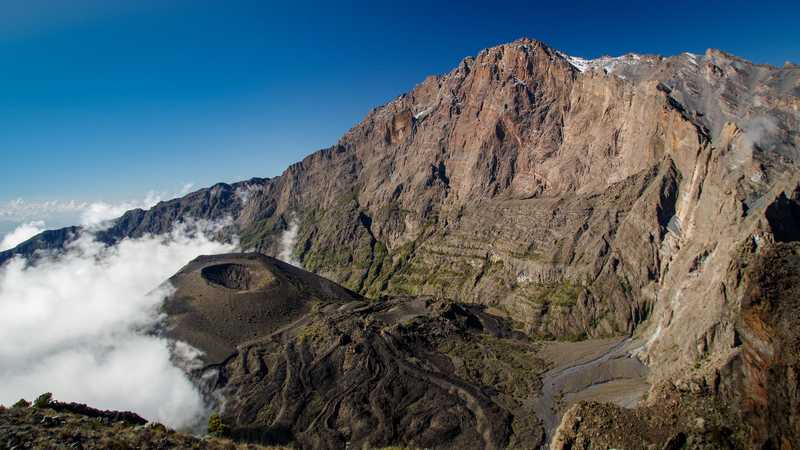 Kilimanjaro
Trekking · Summits
Climb Mount Meru
 Nepal
Summits
Climb Mera Peak
 Ecuador
Multi-activity · Trekking
Ecuador Multi Activity