 Jordan2
 Kilimanjaro9
 Morocco4
 Uganda4
 United Arab Emirates3
 Argentina3
 Chile2
 Cuba2
 Ecuador3
 Guyana2
 Peru12
 Bhutan4
 Indonesia3
 Ladakh4
 Nepal12
 Pakistan1
 France2
 Georgia3
 Greenland2
 Norway2
 Svalbard4
 Trekking
 Summits
 Arctic
 Winter
 Kayaking
 Multi-activity
 Safaris
 Ultimate
 Kandoo Lite
Climb Mera Peak
- 19days
- Challenging
- 6,476 mhighest point
- 6,819 mtotal ascent
- 290 kgCO₂, offset
 Your local teamPimba Tenjing Lama© Adobe Stock
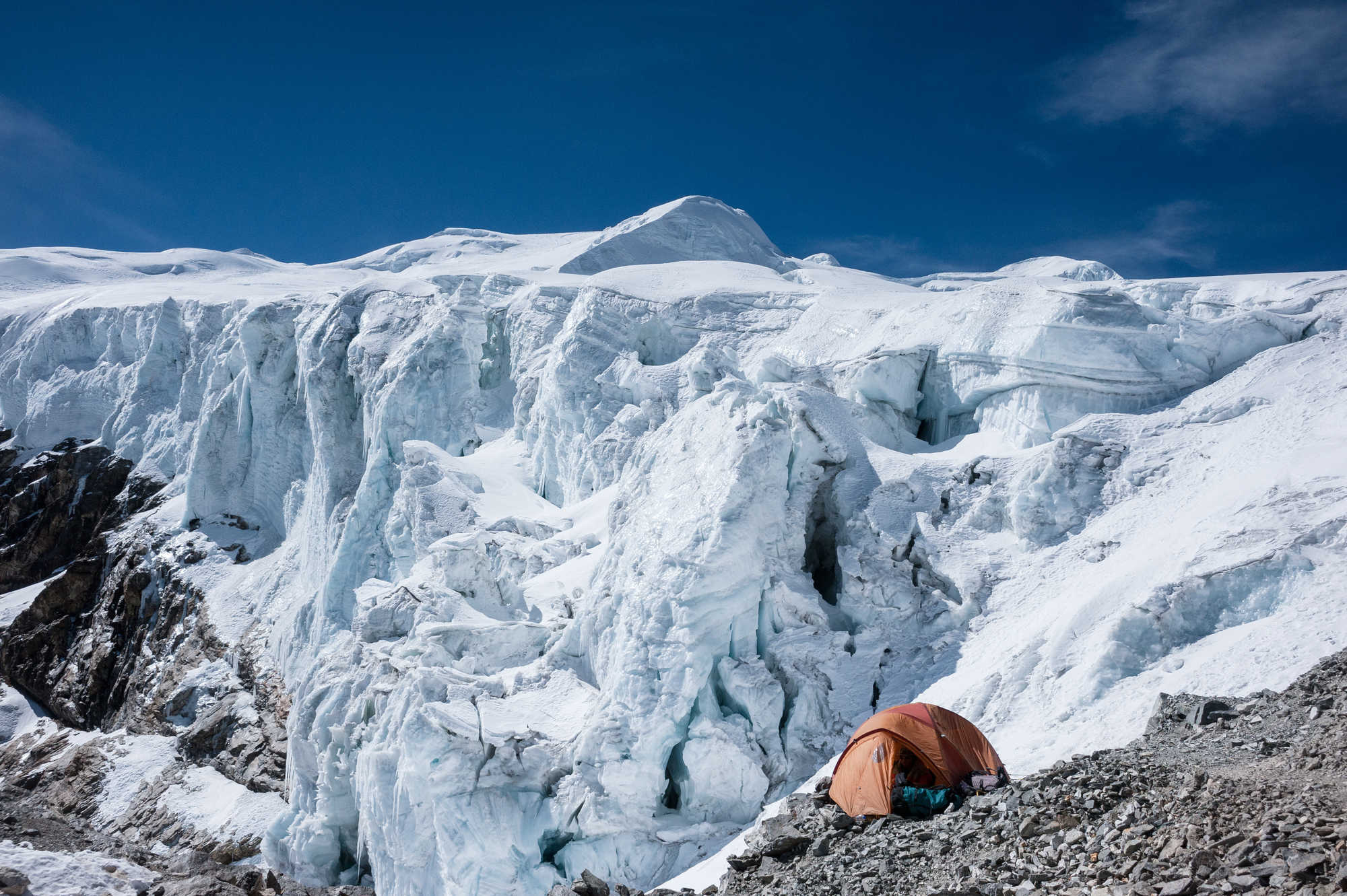
Mera Peak is 6476m and the highest trekking peak in Nepal. At this altitude the oxygen content of air is less than half of what it is at sea level - for this reason we would not recommend you take on Mera as your first high-altitude trek. If you have already reached altitudes over 5000m successfully, then Mera Peak is a great next step. The challenge is very much about stamina and endurance though, as no technical skills are need to complete the climb. We think it is definitely worth the effort!
The expedition starts with a beautiful approach up the Arun Valley which takes you away from all the crowds on the Everest trek . On this part of the trek you will see local villages farming the terraces as they have done for generations. The highlights are the views from high camp, and from the summit itself, which are breath-taking - Everest, Lhotse, Makalu and Baruntse can all be seen clearly. Since you will be climbing through the night on this ascent, you can stop and watch the sunrise capture the heads of these mountains as dawn breaks.
With decades of Himalayan expertise, our veteran guides offer more than just an industry-leading safety record. By trekking with us, you’re giving back through the Kandoo Himalaya Foundation, which funds education and development in Hongong—the remote village many of our team members call home.
Trip highlights
- Summit the highest trekking peak in Nepal
- Approach through the unspoilt Arun Valley
- Lodge and tent-based accommodation
- Extra night in Kathmandu as contingency
- Generally, 8 hours walking, but can up to 16 hours on summit day.
- Up to 1500m daily ascent or 2000m descent.
- Total altitude of up to 6500m.
You should have a high level of fitness and participate in endurance training to prepare for your trip.
19 days, day by day
The line is each day's high point. Flat steps are the rest and acclimatisation days that keep you safe up high.
All trekkers need to organise their own flights to Kathmandu International Airport (KTM). The Kandoo team will meet you at Kathmandu airport and transfer you to your pre-trek hotel. Later you will attend a pre-trek briefing with your Lead Guide to prepare you for the challenge ahead.
- Hotel
The flight is less than an hour but takes us into the heart of rural Nepal and ends with the breath-taking landing at Lukla. From Lukla we descend first to Surke where we cross the river before climbing steeply to Pakhepani and then more gently to Chutok La. From there it is about another hour of undulating Nepali flat (sometimes up, sometimes down!) to Paiya.
- 7 - 8 hours walking
- 1,440 m up
- 15 m down
- Teahouse
- Breakfast
- Flight
The day starts with a gentle descent through mainly cultivated hillsides until we reach the wooden bridge where we cross the Paiya Khola river. After walking through the forest for around an hour we face a tough climb that brings us back up to Kari La, from where there are fantastic views of several 7,000m mountains. We descend through rhododendron trees and traverse on typical Nepali flat for most of the afternoon before we reach the village of Panggom.
- 8 - 9 hours walking
- 105 m up
- Teahouse
We ascend through Sherpa villages for around an hour to reach the Panggom La pass at 3210m from where there is a great view of Mera Peak. We will still be crossing through cultivated land where we will see local villagers and farmers going about their day to day life. We will stop at the Sibuje for lunch before continuing on more Nepali flat to Ningbo. Depending on local conditions, our guide may decide to continue for another hour and a half to Ramailo Dada.
- 6 - 7 hours walking
- 20 m up
- Teahouse
You will be woken at about 2am (maybe earlier depending on the group size) with hot tea and a high energy meal to start our summit ascent of Mera Peak. We start up the main glacier, crossing to the south side as we approach the snow hump-back ridge. This part of the route is not technical but 30 degree slopes are still tough. The slope steepens for a section behind the ridge and then we swing diagonally westward. The summit comes back into view and we are on the level summit ridge. At the foot of the final steep ascent you will attach to a fixed rope laid by your guide and use your ice axe and a jumar to climb the final 30 metre, 55 degree pitch to reach Mera Peak’s summit. A spectacular panorama greets us with clear views over to Everest. Once you’ve had chance to take this all in and congratulate yourself, we will head back down to Khare for a celebration.
- 10 - 12 hours walking
- 676 m up
- 1,491 m down
- Teahouse
- Breakfast / Lunch
Pick your departure
Small groups that run once a few people book, and guaranteed dates that run whatever happens.
- 29 Mar – 16 Apr 2027Monday startOpen for bookings£2,649Book this date
- 19 Apr – 7 May 2027Monday startOpen for bookings£2,649Book this date
- 3 May – 21 May 2027Monday start1 more to confirm£2,649Book this date
- 13 Sept – 1 Oct 2027Monday start1 more to confirm£2,649Book this date
- 4 Oct – 22 Oct 2027Monday startOpen for bookings£2,649Book this date
- 1 Nov – 19 Nov 2027Monday startOpen for bookings£2,649Book this date
Prices per person sharing. “2 more to confirm” means the date runs once two more people book; guaranteed dates run whatever the group size.
- Your hotel stay for one night before and two nights after the trek
- All airport transfers
- Return flight between Kathmandu and Lukla
- National Park entry, TIMS fees & climbing permit
- A fully supported trek with a qualified mountain guide
- All drinking water on the trek
- Teahouse accommodation on a room only basis
- High quality sleeping tents
- All meals when camping on the climb
- Access to emergency oxygen and first aid kit
- International airfares and visas
- Tips for your guides and porters
- Personal items
- Travel insurance (you must be insured, and specifically for treks up to 6500m, using fixed ropes)
- Your personal trekking and climbing gear
- Your personal medicines or prescriptions
- Meals and drinks on the trek (except when camping)
- Meals and drinks in Kathmandu (breakfast is included)
- Additional hotel nights before or after your climb
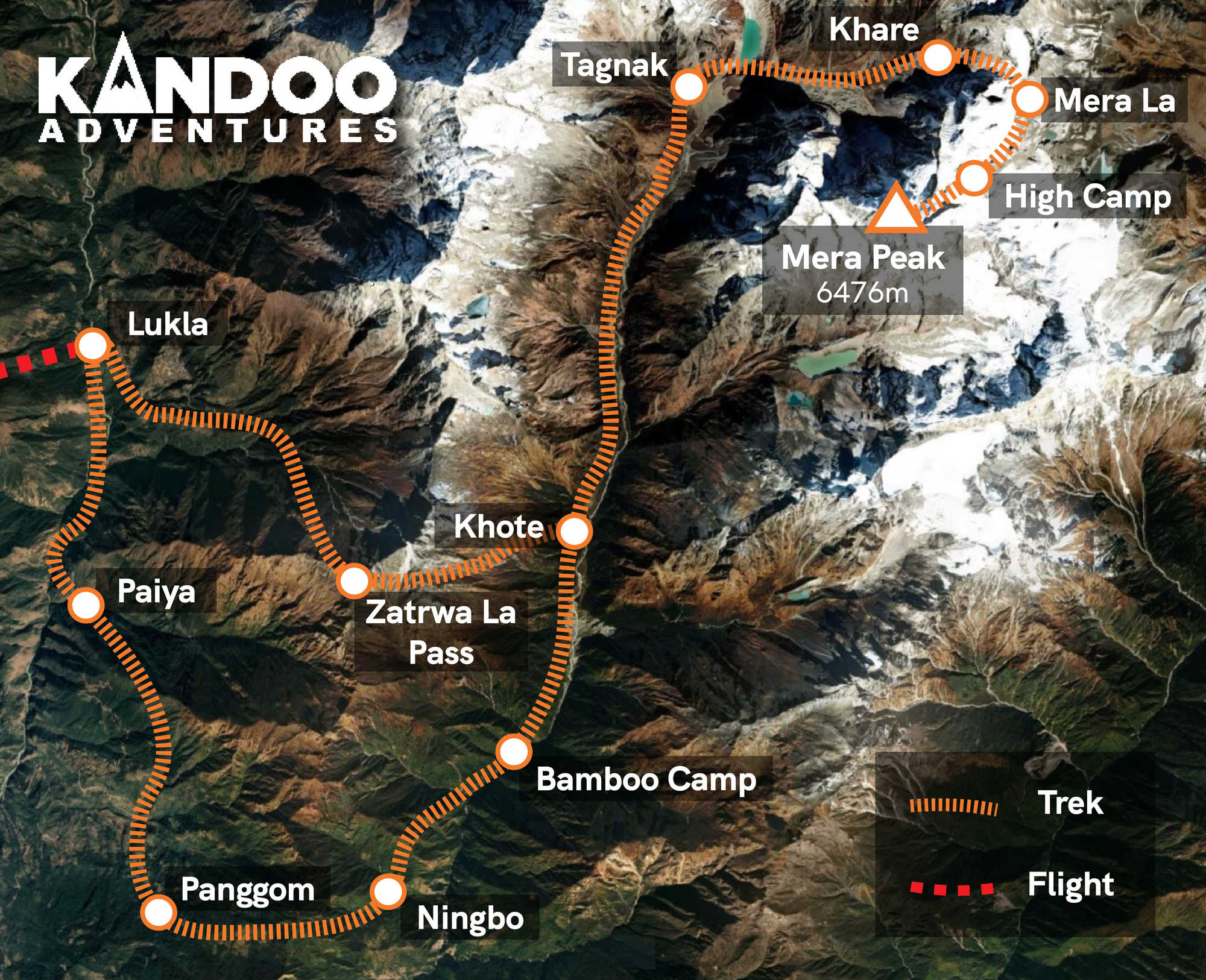 Route map
On the trail
Before you go
Difficulty, food, rooms, kit, money, visas and health, straight from the trip dossier.
Download trip dossierMera Peak is designated by the Nepal Mountaineering Association as a trekking peak. Their criteria for this however, is only that you need to be able to use crampons and ice axe to reach the summit. This can give the impression that Mera Peak is not difficult. This is not true. At 6476m, it is the highest trekking peak in Nepal, and this brings all the challenges of trekking at really high altitude. These include the possibility of extreme weather conditions, and of course, altitude sickness.
Unless you have already been to altitudes above 4000m without any problems, you should probably avoid Mera Peak. In total you will be at, or above, 5000m for 4 days, and unless you acclimatise well this could easily trigger altitude sickness. Besides the altitude, Mera Peak is also a really hard slog. There is no point that is particularly difficult, but the summit night climb up the glacier just goes on and on. Expect to be trekking up the glacier for 5-6 hours to reach the summit! All that effort is, however, extremely worth it for the views at the top!
Looking for training advice or a training plan in preparation for this trip? We'd recommend checking out Kate Sielmann and her coaching programs that are specific to mountaineering and trekking training. Find more details here.
At Kandoo we do not include all meals during your trip and instead, we allow you to choose whatever you like from the menu. Maintaining a good appetite at altitude is essential for a safe and enjoyable trek. Over the years, we have found that giving every traveller the option to choose their meals, rather than providing a restricted inclusive menu, is a much better way of ensuring everyone stays strong and healthy during their trip. This also means you pay a lower cost for your trek and have control over your own food budget (typically this will save you hundreds compared to an all-inclusive option).
The teahouses in the Makalu region these days all offer a wide range of options from local Dhal Bhat (rice and lentil soup) to pasta, pizza and even chicken burgers and yak steaks. The menu will always feature something that takes your fancy regardless of your dietary requirements or preferences. We recommend a budget of £30 to £35 ($40 to $45) per day for meals and drinks. For examples of menus visit our Nepal Trekking Guide.
One word of advice, place your meal order as soon as you can upon arriving at the lodge as it is strictly ‘first ordered, first served’, and the best lodges are quite busy at meal times.
Camping
Camping on Mera Peak is full service. Your guide will cook for you at base camp and at high camp there are cooks who provide food for the whole camp. Your meals will be basic due to the rapidly changing conditions at this altitude, expect Dhal Bhat, garlic soup and mint tea (all designed to help with any altitude sickness). You will also be provided with a packed breakfast for your summit attempt.
Your full day by day itinerary shows what is included in terms of hotel accommodation and meal basis. All of our pre- and post-trek nights are in comfortable 4* hotel accommodation based in the Thamel District of Kathmandu.
You will be staying at teahouses, situated in villages along the trail. The standard of accommodation still varies hugely but on the most popular routes there is generally plenty of clean, well kept accommodation. Rooms are normally twin shares and consist of two wooden bench beds per room with mattresses and sheets. Most will provide blankets but we would certainly recommend bringing your own good quality 4 season sleeping bag unless you are used to sleeping rough in freezing conditions. Whenever possible we will try to book en-suite rooms, but availability is very limited. Generally bathroom facilities will be shared and it will be a short walk to reach them so footwear to use at the teahouses is essential if you don't want to spend the entire trek in your boots. Showers are not always available and it tends to be just the communal areas that are heated.
Wifi is available in almost all villages and you will be able to access the luxury of hot showers at some teahouses. If you wish to use these sundry items then expect to add an additional $15 per day to your food budget. We do probably over-estimate the food cost, but ATMs are pretty much unheard of in the mountains and we would rather you have too much money with you than not enough.
Dining in the lodges will be in a large open room with tables round the outside and a fire in the centre. Our guides try to make sure we secure you a spot away from the door and nearer to the fire but can't always guarantee this.
The toilet situation is something a lot of our guests want to know about! In Nepal, the hotel we use has western flushing toilets. On the trek itself, the teahouses will have squat toilets or "posh squats". This will most likely be a tiled squat toilet with somewhere to wash your hands. We recommend bringing toilet roll with you as you won't find any in the toilets, however you will find it is available to buy at most teahouses.
Camping
On Mera Peak the high camp is a permanent base throughout the season which uses high-altitude mountain tents, to ensure you stay warm, dry and comfortable on your peak climb. Please bear in mind, these are proper mountain tents, designed to cope with extreme conditions so don’t expect to be able to stand up and walk around inside! Meals will be eaten either outside or in your own tents, there will not be a mess tent provided on our peak climbs.
The general standard of driving throughout Nepal is poor and badly regulated. Roads in Kathmandu are very congested, many drivers are not properly licensed and vehicles are poorly maintained. During the monsoon season (June to September) many roads outside the Kathmandu valley are prone to landslides and may become impassable. We insist on using a high standard of vehicle and driver for all of our transfers. In Nepal it is not a legal requirement to have seatbelts fitted in the back of vehicles, and while we try to use vehicles that do have rear seatbelts fitted, this cannot always be guaranteed. If you are unhappy about any aspect of the vehicle or the standard of driving, please speak to the driver or our local office.
Duffel bags
You will be provided with a large duffel bag at the pre-trek briefing that will be yours to use for the duration of your trek. Your equipment will then need to be transferred into this bag. If you are travelling with a duffel bag then it is up to you which bag you choose to use for the trek, if you are travelling with a suitcase then this will need to be left at the pre-trek hotel and collected upon your return as our porters need the bags they carry to be flexible.
The internal flights operate a strict limit of 10kg for your main bag and 5kg for your day sack. This weight limit is particularly tight for the peak climbs because of the climbing kit. We therefore allow a limit of 15kg for your main equipment bag and 5kg for your day sack, and we will arrange for the extra 5kg to travel as excess baggage. There may be times when the airline is unable to carry the excess baggage on the same flight. If this happens, your climbing kit will be re-packed separately, sent on the next available flight and a porter will catch up with you on the trail. You will be given 2 litres of water on arrival in Lukla to fill your bottles for your first day’s trekking, so you do not need to carry water from Kathmandu. All items must be packed in your main equipment bag. They should not be attached to the outside, as we are not responsible if items fall off when the bags are being carried on the trek.
If you are renting equipment in Khare, please allow for the additional weight when you leave Kathmandu, so that your bag does not exceed 15kg for the porters to carry once the climbing kit is added later.
There are several ways to get to Nepal from Europe and the USA all of which involve an international flight to Tribhuvan International Airport which is the main airport in Kathmandu. There are a lot of flights that fly to Kathmandu through the Middle East. Qatar, Gulf and Air Emirates offer daily flights from Europe and the US to Kathmandu, with a stopover at their central hubs. You must be careful though, as some of these layovers are very long indeed. Check the schedules carefully, and consider using Qatar. They seem to have the shortest layovers (at Doha) by a substantial margin. The other alternative is to fly via Delhi, with BA, Air India or Jet and then catch a shorter flight up to Kathmandu. Again be careful of long layovers and be warned - some of the reviews for Air India are less than glowing!
If you are changing airlines or re-checking your luggage at an airport on route, please ensure you leave a minimum of 3 hours between flights. This will account for any delays on arrival, travel time across airports (this can take longer than you think) and time taken to re-check baggage.
Travelling Responsibly
Here at Kandoo, we like to support our guests to make their travel more sustainable. As of 2025, we are offsetting the carbon on all of our trips from arrival in destination to dropping you back off at the airport. As we don't include flight travel in our trips these aren't included in our offsetting calculations, so we are providing you with the calculator below for you to do this yourselves.
eC02 Flights Calculator
Flight changes during Peak Season
Please note that during peak season domestic flights will depart from Ramechhap rather than Kathmandu. Ramechhap is a 5-6 hour drive from Kathmandu and as this is a national alteration concerning all domestic flights to the Everest region, flight companies will provide transfer buses to Ramechhap from Kathmandu. The change has been implemented to put less stress on Kathmandu airport as the number of domestic flights to Lukla increases with the popularity of the region. This will only affect trips to the Everest region not Annapurna. If your trip overlaps the dates these are implemented, you may find that you fly into Lukla via Kathmandu but return via Ramechhap.
Unfortunately, in classic Nepalese style, the exact dates this will affect will not be released until a few months prior to the trekking season starting.
The Nepali Rupee is a closed currency so you will not be able to buy this before you arrive. If travelling from the UK or the US, it is advisable to travel with your home currency and exchange this in Kathmandu. It is very important that bills be new (less than 10 years old), crisp and untorn. We recommend changing currency in Kathmandu rather than at the airport as you will get a much better exchange rate. There are exchange kiosks less than a 5 minute walk from the hotel and your guide will be happy to assist you in finding these should you need them to. Alternatively all the hotels in Kathmandu will change small amounts of money for you.
We recommend that you take local currency on the actual trek with you, as the teahouses prefer local currency. You will also get a more favourable exchange rate in Kathmandu than in the mountains. If you are relying on a credit or debit card for emergency funds, make sure you tell your card issuer that you will be using it abroad, or you may find that it won't work when you really need it.
In Kathmandu a meal for two at a mid range restaurant will cost ~$20. A taxi will generally start on a base rate of $0.45 and then charge $0.4 for every km. Or you can ride the bus which will be around $0.15 for a 5km journey. Souvenirs in Kathmandu are generally on the cheaper side too. Whilst on the trek, we recommend that you budget £30 - £35 ($40 to $45) per day for meals and drinks.
You may also want to be prepared to pay for the cost of a helicopter which can fly in bad weather (around US$300-500 per person), in the case of your flight to or from Lukla being postponed due to bad weather conditions.
Our recommended guidance for spending budget in Nepal would be between $500-800 (depending on the length of the trip and your meal preferences) on top of your tips, to give you ample money for souvenirs and treats.
We realise that tipping may not be a common practice in all countries but for Nepal it is a standard practice that all operators support. The decision on how much to tip should be determined by how well the team served you while you were on the trek. Tips are always discretionary and if you are not happy with the service you have received you do not have to pay tips. Tips can be made in US dollars or Nepali Rupees. It is very important that US bills be new (less than 10 years old), crisp and untorn.
We are members of the Trekking Agencies Association of Nepal and the Nepal Mountaineering Association, and follow their guidelines when recommending tip levels for guides and porters. We would suggest you budget $350 per trekker for your tip contribution on this route. The group tip can be given to your porters and guides during your celebratory meal in Lukla on the final night of your trek. You will then say goodbye to your porters the following morning.
Please double check that your passport is valid for 6 months beyond the date of arrival in Nepal. We recommend that you take a photocopy of your passport and keep it separate from the original, and this will be useful if the original is lost while you are travelling. You must carry your passport on the trek with you, as it is required for internal flights.
Most visitors to Nepal (including nationals from the UK, Europe, USA and Australia) require a tourist visa to enter Nepal. To secure a visa you will need to present proof that you have a return ticket, and proof that you have sufficient money to support yourself during your stay in Nepal. Visa can be obtained online at: https://uk.nepalembassy.gov.np/visa/. Visas are valid for 6 months from the date of issue, so do not send off your application too early.
The other option is to queue and pay for a visa on arrival at Kathmandu Tribhubhan International Airport. This will need to be paid for in cash. We highly recommend securing a visa before departure as this will ensure you have no problems passing immigration, as well as speed up the process of clearing immigration. You will need at least one blank visa page in your passport. Certain nationalities not mentioned above must apply for a visa in advance, so check with your local Nepalese Embassy or online at: https://www.immigration.gov.np/page/visa-on-arrival. If you are flying into Kathmandu, your entry point will be Tribhuvan International Airport.
For most of our trips, you may be ok with a 15 day tourist visa which costs USD30 (around GBP25). However, if you are adding any extra days in Kathmandu you would then require a 30 day tourist visa which USD50 (around GBP40). Visas can be extended once you are in Nepal, but overstaying your visa is taken very seriously, and can result in your being detained or not allowed to leave without paying a fine. In Kathmandu airport they will assume you are paying in your home country currency so make sure you have the amount you need for your visa, or to extend your visa, in cash in your home currency. For smaller currencies, USD will be the best replacement.
The standard vaccinations required are diphtheria, tetanus, typhoid and hepatitis A, but you should always consult your doctor or travel clinic for the most up to date advice.
It is your responsibility to ensure that you are fully and adequately insured for the duration of your trip. Please ensure that all activities, excursions and destinations in your itinerary are included in your travel insurance policy, in addition to your regular cover for cancellation and medical expenses. For the Annapurna and Everest Regions, we recommend cover up to 6000m of altitude. If you are climbing Mera Peak or Island Peak you will need cover for trekking up to 7000m of altitude.
Please take a copy of your insurance policy to the pre-trek briefing, as the guide will need to collect your insurance details. We also ask that you keep a copy of your policy summary (containing policy number and the emergency contact number for your insurer) in your day sack at all times, so that we can access this information should we need to contact the insurer on your behalf.
Malaria
There is no risk of malaria in Kathmandu and or on the majority of Himalayan treks that we operate, due to the altitude. However, there is a risk of malaria in areas of Nepal below 1,500m, particularly in the Terai district, the lowland region of Nepal adjacent to the Indian border. This region includes Chitwan National Park, so if you are planning a safari extension to your trek, you need to plan anti-malarial medication for this part of your trip. In addition to taking medication, we would recommend you take every precaution to prevent mosquito bites by wearing long-sleeved trousers and shirts at dusk and dawn when the mosquitos are active, and by using a DEET based mosquito repellent.
Altitude Sickness
Altitude sickness, also called Acute Mountain Sickness (AMS), hypobaropathy and soroche, is an illness caused by exposure to low air pressure, especially low partial pressure of oxygen, which many trekkers experience at high altitudes. AMS is caused by exerting yourself at high altitudes, especially if you have not been properly acclimatised. It is most common at altitudes above 2400 metres. All our routes in Nepal have been designed to aid your acclimatisation wherever possible, but the following will also help your body adjust:
Slow and steady. You need to keep your respiration rate low enough to maintain a normal conversation. If you are panting or breathing hard, you must slow down. There is no pressure on you to keep up with other members of your group.
Drink much more water than you think you need. Proper hydration helps acclimatisation dramatically. You need to drink at least three litres each day.
Diamox
There has been a lot of research on Diamox that shows it has been reasonably well proven to be helpful in avoiding AMS by speeding up the acclimatisation process. In the UK it is a prescription drug which must be prescribed by a doctor, but some doctors are reluctant to prescribe it. The concern is that by taking Diamox, people believe that they are immune from AMS and can ignore the symptoms. In reality, although Diamox can help prevent the symptoms, should symptoms still develop it means that you are not acclimatising and you have to take notice. Diamox is taken before you start trekking to prevent altitude sickness, not once you are on the trek and symptoms have developed.
Dehydration
You can easily become dehydrated at high altitudes. The lower air pressure forces you to breathe more quickly and deeply, and you lose a lot of water through your lungs. You will also be exerting yourself, and sweating, and may even suffer from diarrhoea. As a result, you will have to drink much more water than you normally would so you should drink at least 3 litres of fluids every day while trekking. Even when you do not feel thirsty you have to drink this amount as a minimum, preferably more. Stay on the look-out for signs of dehydration in yourself and your fellow trekkers. The most common symptoms include thirst, dry lips, nose or mouth, headache and feeling fatigued or lethargic.
We recommend that wherever possible you use your own gear for your trek as this is the best way to ensure your comfort and enjoyment. We recognise though that the cost of some items is very high and this may not be possible.
Duffel bags
You will be provided with a large duffel bag at the pre-trek briefing that will be yours to use for the duration of your trek. Your equipment will then need to be transferred into this bag. If you are travelling with a duffel bag then it is up to you which bag you choose to use for the trek, if you are travelling with a suitcase then this will need to be left at the pre-trek hotel and collected upon your return as our porters need the bags they carry to be flexible.
We do not have other gear available for rental but there are many places offering gear for rental in Kathmandu. The quality of rental gear is very variable and it is your responsibility to check carefully the condition of any item you rent. We accept no responsibility for the quality of equipment hired. An indication of the likely rental costs is below.
Four Season Sleeping Bag - $2 per day
Down Jacket - $2 per day
Trekking Poles - $1 per day
Sleeping Mat - $2 per day (closed cell foam mat; inflatable mats cannot be hired)
For Mera Peak you will also need additional specialist equipment. This can be hired in Kathmandu but is also available to rent at a lodge close to base camp. Prices below are for Kathmandu rental. Prices in the lodges can be more than twice this cost. It is still cheaper though to rent from these lodges as you only need to pay for 3-4 days hire. You should be aware though that the range of sizes and the quality of rental gear available here is even more limited than in Kathmandu and you may not find something that is perfect for you. In addition, climbing boots may have only just been returned by a previous user and may still be wet.
High Altitude Climbing Boot - $3 per day
Crampons - $2 per day
Ice Axe - $2 per day
Climbing Accessories Pack - $12 per day (includes helmet, harness, carabiners, prussik loop, tape sling, ascender & descender)
HEADGEAR
Warm beanie style hat – knitted or fleece
Buff - Essential to prevent the cold air reaching your lungs and causing "Khumbu cough"
Sun hat – preferably wide-brimmed for protection
Sunglasses – high UV protection
Headlamp (plus extra batteries)
Climbing helmet
UPPER BODY
Thermal or fleece base layer (x2)
Long sleeve shirt/tshirt – light or medium weight, moisture wicking (x3)
Short sleeved shirt/tshirt – lightweight, moisture wicking (x2)
Fleece or soft shell jacket (x2)
Insulated jacket – down or primaloft
Lightweight water/windproof hard shell outer jacket
Gloves – lightweight, fleece or quick drying fabric
Gloves – heavyweight, insulated, preferably water resistant
Over mittens – with safety straps
LEGS
Leggings – thermal or fleece base layer (x1)
Trekking trousers – light or medium weight (x2) – convertible trousers work well
Waterproof hard shell trousers – ski pants work fine (x1)
Gaiters
FEET
Climbing boot – insulated, stiff-soled (B3)
Trekking boots – mid weight with good ankle support
Training shoe or similar – to wear around the teahouses
Mid-weight trekking socks (x5 pairs)
Breathable, high-wicking liner socks (x3 pairs)
Thermal trekking socks for upper reaches of your trek (x2 pair)
TREKKING GEAR
Small Rucksack or Daypack (30-40 litres) to carry water and personal items
Waterproof duffle bag (approx 80-100 litres)
Sleeping bag (4 season or -20 Deg C) and compression sack
Sleeping mat
Trekking poles
Water bottle or hydration bag – must be able to carry 1.5-2L of water
CLIMBING GEAR
Crampons – to fit your climbing boots
Ice axe
Climbing harness
Ascending (jumar) and descending (belay) devices
Carabiners – 2 x locking, 2 x non-locking
Prussik loop and tape sling
OTHER ACCESSORIES
Sunscreen - high SPF
Lipbalm – high SPF - ESSENTIAL in Nepal!!
Toiletries, including wet wipes and hand sanitiser – please carry all rubbish back off the trail
Toilet paper - you won't find any in the toilets, but it is available to buy at most teahouses
Camera and spare batteries
Plug adapter, for charging devices in teahouses and hotels
Personal medication and first aid kit
Personal snacks and energy bars – dried fruit and nuts are a good option
Isotonic drink powder / energy drink powder to mix in with your water
Microfibre towel for wiping hands and face each day
Pee bottle, useful for late night toilet needs
Trusted by people who
wanted more than a view
4.9 Excellent · 1,249 reviews · 97% five-starThe Three Passes Trek, NepalMy son and I have just completed the Three Passes Trek with Kandoo. I can’t praise the team in Nepal enough. Our Head Guide Chessung was amazing through the whole trek. Totally professional, calm, in control, great company, funny, engaging, informative. Nothing was a problem, from changing the itinerary, to sorting out helicopter extraction due to the incoming bad weather.
Excellent experienceExcellent service delivery from the time I booked to the end of the trip. Dorchi La as our guide was always calm and collected with a great sense of humour. Answering my numerous questions every night was probably the highlight and he answered all with immense patience.
Hiked EBC in Nepal with KandooProfessional, clear and well-organised group. I enjoyed my time and felt really safe through it all. Highly recommend.
More like this
 Nepal
Summits
Everest Base Camp and Island Peak
 Nepal
Trekking
Poon Hill Trek
 Bhutan
Trekking
Snowman Trek
 Georgia
Summits · Trekking
Climb Mount Kazbek
 EcuadorSale
Trekking
Ecuador Volcanic Adventures
 ArgentinaSale
Summits
Climb Aconcagua