 Jordan2
 Kilimanjaro9
 Morocco4
 Uganda4
 United Arab Emirates3
 Argentina3
 Chile2
 Cuba2
 Ecuador3
 Guyana2
 Peru12
 Bhutan4
 Indonesia3
 Ladakh4
 Nepal12
 Pakistan1
 France2
 Georgia3
 Greenland2
 Norway2
 Svalbard4
 Trekking
 Summits
 Arctic
 Winter
 Kayaking
 Multi-activity
 Safaris
 Ultimate
 Kandoo Lite
The Salkantay Trek
- 8days
- Moderate
- 4,600 mhighest point
- 1,200 mtotal ascent
- 113 kgCO₂, offset
 Your local teamJosé Quispe© Unsplash
The Salkantay Trek is a beautifully scenic journey through a striking diversity of landscapes, where lush lowland jungles seamlessly give way to high-alpine meadows and dramatic glaciated peaks. For travellers seeking a quieter, less-trodden alternative to the classic trails, this route offers the perfect path to Machu Picchu.Your adventure begins in Cuzco, the ancient capital of the Incan Empire. Here, you will spend two days immersing yourself in the vibrant local culture while giving your body vital time to acclimatise to the altitude.
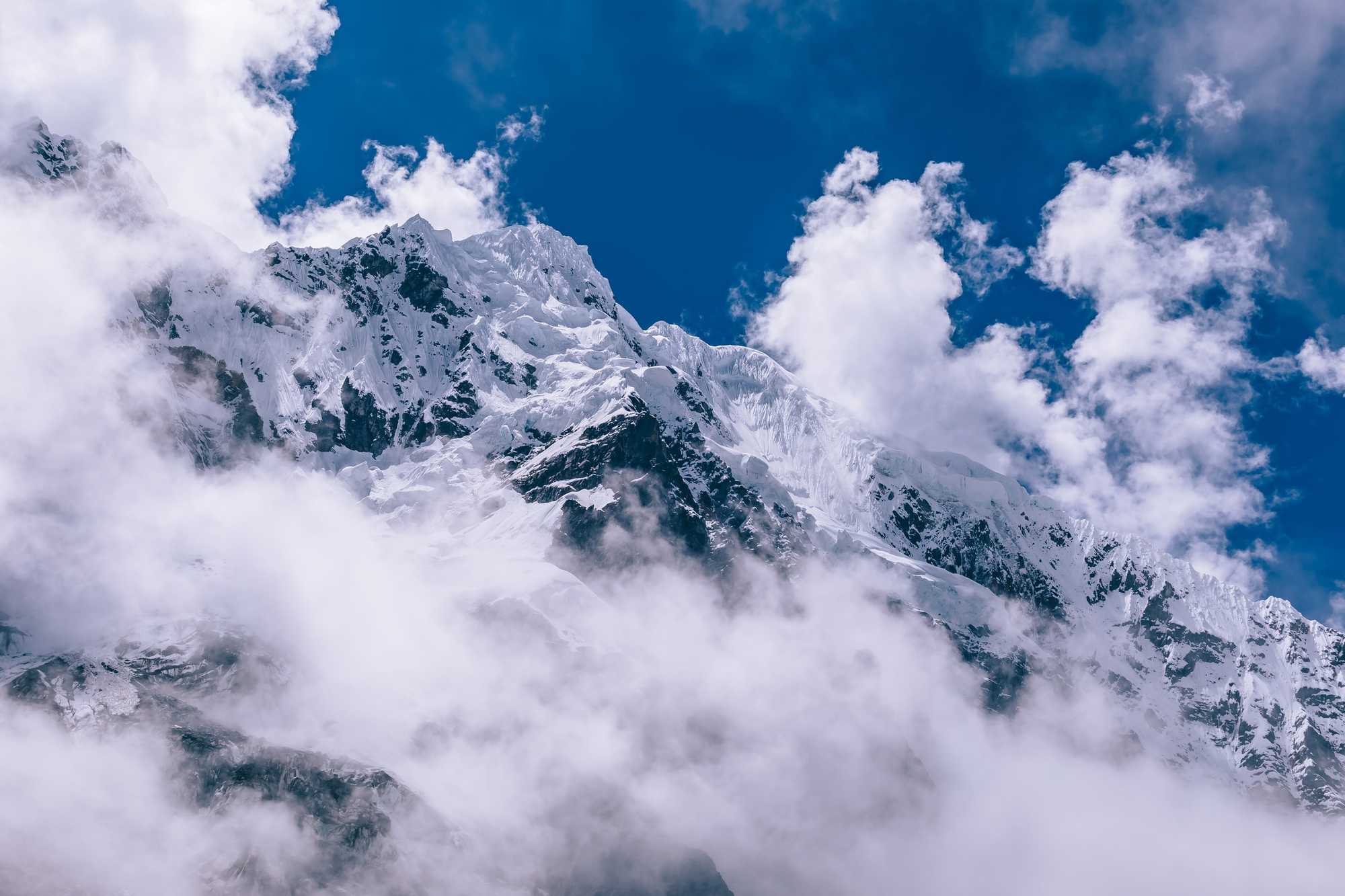
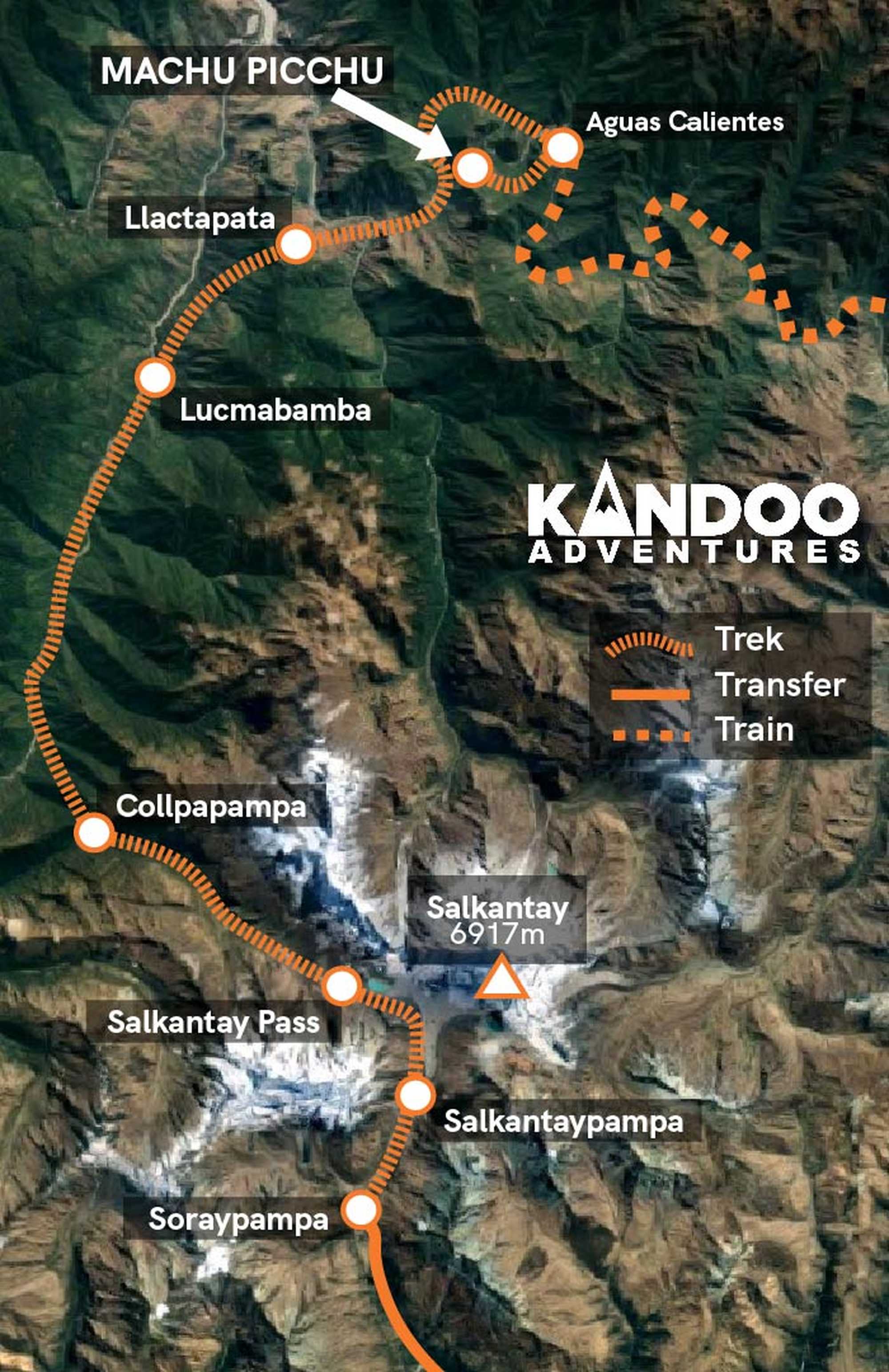
The trek kicks off with an unforgettable hike to Humantay Lake, a brilliant turquoise glacial gem cradled by mountains. From there, you will journey toward the northwest, where the region’s highest peak—the magnificent Nevado de Salkantay (6,271m)—dominates the skyline. True to its name, which translates to the "Savage Mountain," this imposing single peak serves as the spectacular focal point of your trek. After conquering the breathtaking Salkantay Pass at 4,600 metres, you will descend toward Aguas Calientes, the final gateway to the ancient ruins of Machu Picchu.
We have been guiding travelers through the Andes Mountains to Machu Picchu for over 12 years. Led by our in-country manager and immensely experienced local guide, José Quispe, our focus on safety and exceptional service has allowed thousands of adventurers to explore these iconic routes in comfort.
Trip highlights
- Trek through the remote Salkantay valley
- Fascinating range of bio-diversity
- Comfortable 4 star hotel in Cuzco
- Extra day for acclimatisation
- 6 to 8 hours walking or activity each day.
- Up to 1200m of vertical ascent per day.
- You may be reaching altitudes over 4000m.
You should have a good level of fitness and be accustomed to long days of hiking.
8 days, day by day
The line is each day's high point. Flat steps are the rest and acclimatisation days that keep you safe up high.
All trekkers need to organise their own flights to Cuzco Airport (CUZ). From the airport we will arrange an airport transfer for you to our hotel in Cuzco
- Hotel
The city of Cuzco sits at an altitude of 3400m and is a great place to acclimatise before you start your Salkantay trek. You’ll have plenty of time to explore this charming city and soak up the local atmosphere. This evening you will meet your Kandoo guide and have a full pre-trek briefing.
- Hotel
- Breakfast
We will pick you up early from your hotel for a private transfer to the start of our trek, which will take around 4 hours. Along the way, we will pass through the picturesque towns of Pampa de Anta (Izcuchaca, Zurite, and Ancahuasi). Our journey will take us into the Limatambo Valley and then toward Soraypampa, where we will begin our expedition. At Soraypampa, we will complete the arrangements for our trek and meet our arrieros (horsemen). We begin by hiking up to Humantay Lake, the stunning turquoise lake at the base of the Humantay glacier. We then continue to ascend to our campsite at Salkantaypampa. From here we have great views of the peaks of Tucurway (5910m), Humantay (5917m) and Salkantay (6917m).
- 5 - 6 hours walking
- 600 m up
- Camping
- Breakfast / Lunch / Dinner
At the start of the second day of trekking we ascend to the highest point of our trek, the Salkantay Pass (4600m) from where we can enjoy the views of Mount Salkantay, a stunning snow-capped mountain (6271m). A further 3 hours walking with spectacular views of the mountains Humantay and Huayanay will bring us to our lunch site, Huayraqmachay (3700m). We then descend for 3½ hrs until we reach our second campsite, Collpapampa.
- 8 - 9 hours walking
- 600 m up
- 1,700 m down
- Camping
- Breakfast / Lunch / Dinner
Pick your departure
Small groups that run once a few people book, and guaranteed dates that run whatever happens.
- 19 Nov – 26 Nov 2026Thursday startSold out£1,349Sold out
- 3 Dec – 10 Dec 2026Thursday start2 more to confirm£1,349Book this date
- 26 Dec – 2 Jan 2027Saturday startSold out£1,349Sold out
Prices per person sharing. “2 more to confirm” means the date runs once two more people book; guaranteed dates run whatever the group size.
- Your hotel stay for the nights before and after the trek
- Airport transfers
- Transfer to and from the trek start point
- Machu Picchu entry and camping fees
- A fully supported trek
- All meals and drinking water on the trek
- A private portable toilet
- High quality mess and sleeping tents with a comfortable insulated sleeping mat
- Access to emergency oxygen and first aid kit
- Airfares and visas
- Tips for your guides and crew
- Personal items
- Travel insurance (you must be insured, and specifically for treks up to 5000m)
- Your personal trekking gear
- Your personal medicines or prescriptions
- Snacks on the trek
- Meals and drinks not on the trek
- Additional hotel nights before or after your trek
 Route map
On the trail
Before you go
Difficulty, food, rooms, kit, money, visas and health, straight from the trip dossier.
Download trip dossierIn general, the Salkantay Trek is considered more difficult than the Inca Trail. You will be trekking at least 6 or 7 hours each day for four days, over mountain trails. Day 2 and Day 4 of the trek are the toughest days. On day 2 you will be climbing over the Salkantay Pass at 4,650 metres and will feel the effects of altitude. The hike from Lucmabamba to Aguas Calientes on Day 4 is hard, although relatively flat - it is a long day, taking around 8-9 hours. Due to the high altitude reached, and the long hours trekking each day, a good level of fitness is required.
Staying well-fed on your trek is absolutely vital, especially when conditions are such that you might not want to eat or drink as much as you should. Because so many trekkers experience a loss of appetite at altitude, our head chef has developed special menu plans that are appealing, healthy, and filled with all the energy you need to make it to Machu Picchu. By default, our meals include fresh fruit and vegetables every day, as well as fresh meat and fish.
BREAKFAST
Breakfast is usually fairly hearty. Of course, you’ll also have hot drinks, generally a choice of tea, coffee or hot chocolate. Let your guide know if you are still hungry, or even if you think you could ‘pack in a few more bites’. Our cooks always try to provide more food than necessary to ensure everyone gets a good meal.
LUNCH
Lunch is packed for you, to carry in your rucksack.
AFTERNOON TEA
Afternoon Tea is served at the end of the days walking, once you get to camp. In addition to tea and other hot drinks, there are plenty of snacks to help restore some of the energy you’ve just burned off.
DINNER
Dinners are quite filling. They usually begin with a nice hearty soup, and then a main course with fresh vegetables, and plenty of rice, pasta or potatoes, followed by a yummy dessert.
DRINKING WATER
On the trek, we filter and boil all the water that we give to you for drinking. You may wish to bring purification tablets as an extra precaution but they are not essential. Every morning we will fill up your water bottles or hydration bladder with at least 2 litres of water.
COCA TEA
Coca tea is thought to help relieve the symptoms of altitude sickness. In Cuzco, all the hotels have dried leaves and hot water available throughout the day so you can make your own tea whenever you wish. On the trek we will take coca leaf tea bags for you.
We use only the very best high altitude mountain tents, Eureka K-2 XT, to ensure you stay warm, dry and comfortable on your Salkantay trek. Please bear in mind, these are proper mountain tents, designed to cope with extreme conditions so don’t expect to be able to stand up and walk around inside!
Your meals will be taken in a separate mess tent where you will be able to sit comfortably, while you relax and chat to your team mates and enjoy the wholesome food that our cook has freshly prepared for you. Inside, you’ll be pleased to find a table (of course) and a proper, comfortable chair. With a full 2 metres of headroom, even the tallest climbers will be able to stretch a bit, and move about without hunching over. They are fully waterproof, and regularly withstand the worst weather the Andes has to offer.
The hotels in we use in Peru all have western, flushing toilets. Whilst on the trek the toilet situation will be a little less luxurious. At camp each evening we will set up a toilet tent. This is a simple facility that provides a little privacy and comfort whilst on the trail. The toilet tent will contain a portable toilet seat set up on a stand above a bag. Whilst trekking, if you need to go you will have to find somewhere hidden, off the path and go wild. There's plenty of places to hide in the Peruvian forests!
Our pre- and post-trek accommodation is based in Cuzco, with an additional night in Aguas Calientes after the trek. Where your hotel basis is B&B, you can usually purchase snacks or meals at the hotel, which can be paid in Peruvian Sols, or often in US Dollars. Alternatively, there are plenty of restaurants in Cuzco within walking distance of your hotel.
We insist on using a high standard of vehicle and driver for all of our transfers. In Peru it is not a legal requirement to have seatbelts fitted in the back of vehicles, and while we try to use vehicles that do have rear seatbelts fitted, this cannot always be guaranteed. If you are unhappy about any aspect of the vehicle or the standard of driving, please speak to the driver or our local office immediately.
Bag Weight: 7kg
Kandoo Adventures operates a strict limit of 7kg for your main equipment bag. This limit includes your sleeping bag, even if it is rented from us. This is more than sufficient for your needs on the trek. Your bag will be weighed before you leave the hotel to start the trek and if it is overweight you will have to take items out and leave them at the hotel.
There several good ways to get to Cuzco from the UK. The first is to fly KLM to Lima with a stopover in Amsterdam. The second is to fly with Air France who offer flights to Lima via Pairs, or alternatively you can use Iberia who fly to Lima via Madrid. From Lima you will have to get a domestic flight to Cuzco. Domestic airlines include LATAM, Avianca, Star Peru or Peruvian Air. We recommend flying with LATAM as their planes have the capability to land in the foggy conditions that can affect Cuzco and Lima. Most flights from Europe land in the evening, local time. Most flights for Cuzco don’t leave until the morning, so if you don’t fancy loitering in the airport all night (which we do not recommend), you’ll need an overnight stay in Lima.
Trekkers starting off in North America have a much wider set of options. American Airlines and US Airways both offer flights into Lima, as do several other carriers. In addition to existing security measures at international airports, passengers MAY be required to show that the electronic devices in their hand luggage are charged up. You may therefore be asked to turn on any electronic devices such as mobile phones, tablets, e-books and laptops in front of the security team and/or demonstrate the item’s functionality. We recommend that any electronic devices that you are carrying in your hand luggage are fully charged before you travel. If you have any further questions then you should check with your departure airport.
If you are changing airlines or re-checking your luggage at an airport on route, please ensure you leave a minimum of 3 hours between flights. This will account for any delays on arrival, travel time across airports (this can take longer than you think) and time taken to re-check baggage.
Travelling Responsibly
Here at Kandoo, we like to support our guests to make their travel more sustainable. As of 2025, we are offsetting the carbon on all of our trips from arrival in destination to dropping you back off at the airport. As we don't include flight travel in our trips these aren't included in our offsetting calculations, so we are providing you with the calculator below for you to do this yourselves.
eC02 Flights Calculator
The local currency is the Peruvian Sol which can be purchased in advance of your trip. If you want to change money when you arrive we can take you to an ATM or foreign exchange bureau. When changing money, request small denominations (10’s, 20’s and 50’s) as the larger notes can be hard to spend. If you withdraw money from an ATM, you are likely to receive 100 sol notes. Peru is generally still a cash society, particularly whilst you are travelling through the smaller villages and towns it is worth having enough cash with you for personal expenses. ATMs will also not be available in these areas so ensure you have exchanged enough money whilst in Cuzco, before leaving on your trek. If you are relying on a credit or debit card for emergency funds, make sure you tell your card issuer that you will be using it abroad, or you may find that it won't work when you really need it.
Peruvian Sol should be used for spending money and tipping the crew.
In Cuzco, the cost of public transport is around 22p (33 cents) for a one-way ticket. If you prefer to travel by taxi, starting price is about £1.10 (US$1.40) for a 1km ride. When eating out, a meal in a budget restaurant for 2 people is around £5 (US$7) or a mid range restaurant (for 2 people) will cost around £22 (US$28). For souvenirs to take home, we recommend budgeting around £40 (US$50) which should get you plenty of little gifts. If you wish to buy a big blanket or poncho then budgeting a little more would be worthwhile.
Our recommended guidance for spending budget in Peru would be between £80-100 ($100-125) on top of your tips, to give you ample souvenir and meals out spending money.
We realize that tipping may not be a common practice in all countries but for Peru it is a standard practice that all operators support. The decision on how much to tip should be determined by how well the team served you while you were on the trek. Tips are always discretionary and if you are not happy with the service you have received you do not have to pay tips. Tips can be made in Peruvian Sol.
These are the recommended tips per trekker per day. You will be provided with tip recommendations for your specific trip 3 weeks prior to departure that will give an accurate representation of how much you will need for tips based on the size of your group.
Lead guide: $20
Assistant Guide: $12
Cook: $12
Assistant Cook: $9
Porter (amount per porter): $6
Tent helper (amount per tent helper): $6
Horseman (amount per horseman): $10
Different crew members will be with you for different stages of your trip to Peru:
Your guide/s will be with you every day in Peru.
Your cook/s, porters, tent helpers and horsemen will be with you while you are on the trek itself (The number of porters, tent helpers and horsemen will differ depending on group size. You will be given this information three weeks before departure)
An assistant guide and cook will only be necessary for larger groups (You will be given this information three weeks before departure)
Please double check that your passport is valid for 6 months beyond the date of arrival in Peru. We recommend that you take a photocopy of your passport and keep it separate from the original, and this will be useful if the original is lost while you are travelling.
Most visitors (including nationals from the UK, Europe, USA and Australia) do not require a visa to enter Peru, and will be granted a 183 day stay. You will need at least two blank visa pages in your passport. Certain nationalities not mentioned above must apply for a visa in advance, so check with your local Peruvian Embassy.
Chinese and Indian nationals may enter Peru without a visa if they have a UK, Canada, Australia, Schengen or US visa valid for a minimum of 6 months at the time of entry to Peru.
The standard vaccinations required for Peru are diphtheria, tetanus, typhoid and hepatitis A, but you should always consult your doctor or travel clinic for the most up to date advice. Yellow Fever is recommended for some areas of Peru, which includes the Amazon basin.
It is your responsibility to ensure that you are fully and adequately insured for the duration of your trip. Please ensure that all activities, excursions and destinations in your itinerary are included in your travel insurance policy, in addition to your regular cover for cancellation and medical expenses. Most of our treks in Peru do not exceed 4700m with the exception of the Ausangate Trek which will reach 5200m. If you are only doing the Short Inca trail your trek will not exceed 3500m. Please ensure that your insurance policy covers you for trekking at these altitudes.
We ask that you keep a copy of your policy summary (containing policy number and the emergency contact number for your insurer) in your day sack at all times, so that we can access this information should we need to contact the insurer on your behalf.
Altitude Sickness
Altitude sickness, called soroche in Peru and also known as Acute Mountain Sickness (AMS) or hypobaropathy, is an illness caused by exposure to low air pressure, especially low partial pressure of oxygen, which many climbers experience at high altitudes. AMS is caused by exerting yourself at high altitudes, especially if you have not been properly acclimatised. It is most common at altitudes above 2400 metres. Our routes have been designed to aid your acclimatisation wherever possible, but the following will also help your body adjust:
Slow and steady. You need to keep your respiration rate low enough to maintain a normal conversation. If you are panting or breathing hard, you must slow down. There is no pressure on you to keep up with other members of your group.
Drink much more water than you think you need. Proper hydration helps acclimatisation dramatically. You need to drink at least three litres each day.
Diamox
There has been a lot of research on Diamox that shows that it has been reasonably well proven to be helpful in avoiding AMS by speeding up the acclimatisation process. In the UK it is a prescription drug which must be prescribed by a doctor, but some doctors are reluctant to prescribe it. The concern is that by taking Diamox, people believe that they are immune from AMS and can ignore the symptoms. In reality, although Diamox can help prevent the symptoms, should symptoms still develop it means that you are not acclimatising and you have to take notice. Diamox is taken before you start treking to prevent altitude sickness, not once you are on the mountain and symptoms have developed.
Malaria
There is no risk of malaria in Cuzco or on the Inca Trail due to the altitude. However, there is a risk of malaria in rural areas of Peru below 2,000m. This would include Tambopata National Park, so if you are planning an extension to the Amazon Rainforest, you need to plan anti-malarial medication for this part of your trip. In addition to taking medication, we would recommend you take every precaution to prevent mosquito bites by wearing long-sleeved trousers and shirts at dusk and dawn when the mosquitos are active, and by using a DEET based mosquito repellent. If you are planning on taking Diamox, please let your doctor know, as daily malaria tablets taken alongside Diamox can cause an upset stomach and nausea. A weekly malaria tablet may be a better option, but you would need to discuss this with your doctor.
Dehydration
You can easily become dehydrated at high altitudes. The lower air pressure forces you to breathe more quickly and deeply, and you lose a lot of water through your lungs. You will also be exerting yourself, and sweating, and may even suffer from diarrhoea. As a result, you will have to drink much more water than you normally would and you should drink at least 3 litres of fluids every day while climbing. Even when you do not feel thirsty you have to drink this amount as a minimum preferably more. Stay on the look-out for signs of dehydration in yourself and your fellow climbers. The most common symptoms include thirst, dry lips, nose or mouth, headache and feeling fatigued or lethargic.
High quality mess and sleeping tents with a comfortable insulated sleeping mat
RENTAL GEAR
If you’ve decided to rent gear, then below is a list of equipment available. Just let our team know what you’d like to hire at your Pre-Trek Briefing.
All payments are made locally in US Dollars (cash only):
North Face 0° Sleeping Bags $15 per trek
Trekking Poles $10 per trek
Duffle Bag $5 per trek
All items must be packed in your main equipment bag. They should not be attached to the outside, as we are not responsible if items fall off when the bags are being carried on the trek. The sleeping bags weigh approximately 2kg each
HEADGEAR
Warm beanie style hat – knitted or fleece
Neck gaiter or scarf - comes in useful for keeping dust out and can double as a warm layer for your neck / face!
Sun hat – preferably wide-brimmed for protection
Sunglasses – high UV protection
Headlamp (plus extra batteries)
UPPER BODY
Thermal or fleece base layer (x1)
Long sleeve shirt/tshirt – light or medium weight, moisture wicking (x 1)
Short sleeved shirt/tshirt – lightweight, moisture wicking (x2)
Fleece or soft shell jacket (x1)
Insulated jacket – down or primaloft
Lightweight water/windproof hard shell outer jacket
Poncho – a cheap plastic poncho is the best way to cope with a sudden downpour
Gloves – lightweight, fleece or quick drying fabric
LEGS
Trekking shorts (x1)
Trekking trousers – light or medium weight (x1) – convertible trousers work well
Waterproof hard shell trousers – ski pants work fine
FEET
Trekking boots – mid weight with good ankle support
Training shoe or similar – to wear around camp
Mid-weight trekking socks (x3 pairs)
Breathable, high-wicking liner socks (x2 pairs)
Small Rucksack or Daypack (25-30 litres) to carry water and personal items
Lightweight duffle bag (approx 50 litres) – max weight when full should be 10kg. This weight restriction includes your sleeping bag, whether you brought one with you or rented one from us. Your duffle will be carried by a mule
Sleeping bag (3 season or 0 Deg C) and compression sack
Trekking poles
Water bottle or hydration bag – must be able to carry 1.5-2L of water
OTHER ACCESSORIES
Sunscreen high SPF
Toiletries, including toilet paper, wet wipes and hand sanitiser – please carry all rubbish back off the trek
Camera and spare batteries
Personal medication and first aid kit
Insect repellent – ideally contains DEET
Personal snacks and energy bars – dried fruit and nuts are also a good source of energy
Isotonic drink powder / energy drink powder to mix in with your water. This improves flavour and helps replace electrolytes
Microfibre towel for wiping hands and face each day
Ear plugs, if you are a light sleeper
Pee bottle, if you prefer not leaving the tent at night
Dry bag (only required if your main duffle bag is not waterproof)
Trusted by people who
wanted more than a view
4.9 Excellent · 1,249 reviews · 97% five-starPeru, Classic Inca Trail, what an adventure!My second trek with Kandoo (previously did the Lemosho route of Kili) and another exceptional experience. Once in Peru our guide Jose and his assistant Walter were amazing, full of information, stories and good vibes. Special mention to Carmelo our chef whose food was outstanding every meal.
Kandoo, highly recommend!This was our second adventure with Kandoo and it was even better than the first! I became quite ill in the lead up to my trip. Shelley and the team in the office were so good in allowing me some flexibility with extending my balance payment, so that I could await clearance from the doctor.
Jose & Walter were fantasticTheir passion and knowledge was superb. I have done Kili and Toubkal with Kandoo and hands down this trip was the best food. The extra thick mattresses were a welcome addition, really helps with sleeping.
Machu Picchu was an incredible experienceThis is the first time that I’ve ever done any hiking like this, and I couldn’t be more pleased with the way our porters, our guide and even our cook handled everything. We’re not talking peanut butter sandwiches and baked beans. This is truly gourmet cooking!