 Jordan2
 Kilimanjaro9
 Morocco4
 Uganda4
 United Arab Emirates3
 Argentina3
 Chile2
 Cuba2
 Ecuador3
 Guyana2
 Peru12
 Bhutan4
 Indonesia3
 Ladakh4
 Nepal12
 Pakistan1
 France2
 Georgia3
 Greenland2
 Norway2
 Svalbard4
 Trekking
 Summits
 Arctic
 Winter
 Kayaking
 Multi-activity
 Safaris
 Ultimate
 Kandoo Lite
The O Trek
- 10days
- Challenging
- 1,241 mhighest point
- 5,914 mtotal ascent
- 121 kgCO₂, offset
 Your local teamEduardo© Kandoo
Escape the chaos of daily life and reconnect with nature on the ultimate Chilean adventure. The Torres del Paine "O" Circuit blends the iconic sights of the "W" Trek with the untouched beauty of the park's quiet northern wilderness. This route packs a serious punch for trekking enthusiasts, featuring long, strenuous days and the legendary John Gardner Pass crossing. Your reward? An exclusive, peaceful journey through remote landscapes that most visitors never get to experience.
Trip highlights
- Experience the awe-inspiring view of the three iconic granite towers
- Fill your bottle with pure, fresh water straight from nature's tap
- Look out at the turquoise glacial crevasses of the Southern Patagonian Ice Field
- Trip fully carbon offset as standard
- Generally, 8 hours walking, but can up to 16 hours on summit day.
- Up to 1500m daily ascent or 2000m descent.
- Total altitude of up to 6500m.
You should have a high level of fitness and participate in endurance training to prepare for your trip.
10 days, day by day
The line is each day's high point. Flat steps are the rest and acclimatisation days that keep you safe up high.
Welcome to Patagonia! One of our team will pick you up at the Puerto Natales airport and transfer you to your hotel. You will then have free time the rest of the day, take a walk around the small, brightly coloured town with it's delightful 'Costanera'. At 6pm, your guide will come to your hotel for a pre-trek briefing to prepare you for embarking on the 'O' Trek.
- Hotel
This morning we will embark on our 'O' circuit trek. Our transfer will take us to the majestic Torres del Paine National Park. When we arrive at Las Torres, we will pass by the Welcome Center before starting our hike along the peaceful Serón Sector. This will take us through the Enchanted Valley, its name hailing from the unique and “enchanted” forms of granite towers standing tall amidst the shrubbery. Some of the towers yield surprising trees, perched on their crests and wedged in between, home to the impressive Condors soaring overhead. From here, we enter an old, native Lenga tree forest by a special kind of lichen, known as “old man’s beard”, which only grows in the purest of atmospheres. You’ll hear them but can you see the woodpeckers up high in the trees? You’ll have time to explore as we are camping here tonight.
- 5 - 6 hours walking
- 375 m up
- 360 m down
- Camping
- Breakfast / Lunch / Dinner
This long, yet unforgettable day will take us up and down the foothills of the Paine Massif mountain range with magnificent photo opportunities along the way of towering peaks crowned with fluffy, white clouds. To reach Lake Dickson we will descend down to the shore of Lake Paine, it's beautiful, green waters the forefront to a stunning backdrop of the surrounding peaks. A gentle stroll along the flood plains of the meandering riverbed and across a section of boardwalks, brings us to a short steep climb up and back down to our remote campsite at Lake Dickson.
- 8 - 9 hours walking
- 549 m up
- 484 m down
- Camping
- Breakfast / Lunch / Dinner
We make the most of the shorter trekking day ahead, by waking up early and revelling in the silence on the lakeside as the clouds pass over the snowy, mountain peaks. Once we have indulged in the surrounding scenery, we will continue on our adventure, taking us through another ancient Lenga forest, home to the handsome Magellan woodpecker. On the last stretch of the trail, we break the treeline and can marvel at the Los Perros Glacier as it hangs forebodingly above a serene, grey lagoon. Tucked away in the forest overlooking the lagoon lies our campsite.
- 5 - 6 hours walking
- 591 m up
- 220 m down
- Camping
- Breakfast / Lunch / Dinner
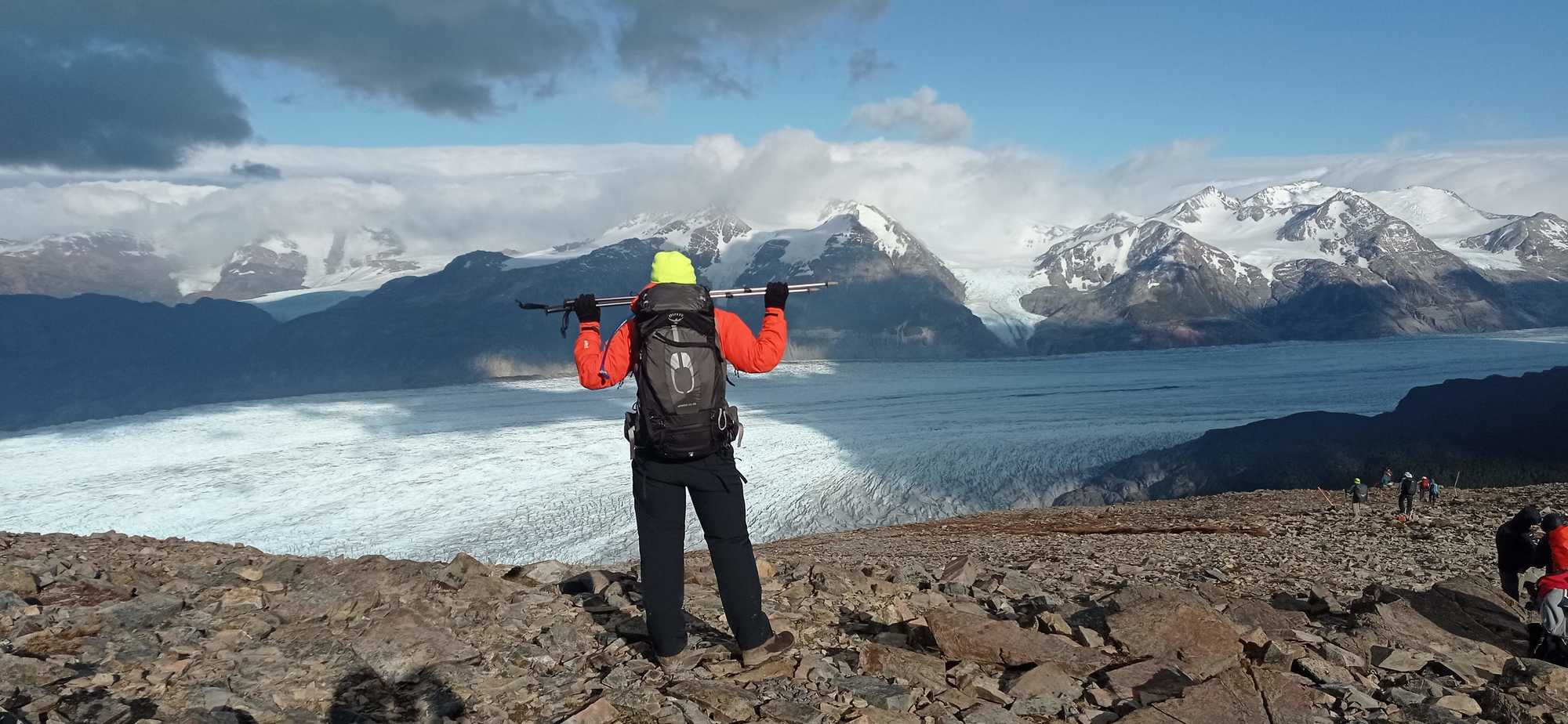
Today will be the hardest but most rewarding day of the circuit. We will leave Los Perros campsite very early and begin the uphill zigzag through the forest’s humid terrain. The path here is often very boggy and the going is slow as we weave our way around tree roots. The trees then deplete and give way to a barren, scree-filled landscape. We are exposed to everything the weather wishes to throw at us as we ascend a steep, scree section, passing a few false peaks, before being treated to the striking views at the top of the John Gardner Pass . We marvel at the beauty of the Southern Patagonian Icefield before beginning the unforgiving descent through the woods, followed by a long slog along an undulating balcony path to reach Lake Grey.
- 10 - 12 hours walking
- 983 m up
- 1,531 m down
- Camping
- Breakfast / Lunch / Dinner
Pick your departure
Small groups that run once a few people book, and guaranteed dates that run whatever happens.
- 28 Feb – 9 Mar 2027Sunday start2 more to confirm£3,349save £50Book this date
- 7 Mar – 16 Mar 2027Sunday startOpen for bookings£3,349save £50Book this date
- 28 Nov – 7 Dec 2027Sunday startOpen for bookings£3,549save £50Book this date
- 20 Dec – 29 Dec 2027Monday startOpen for bookings£3,549save £50Book this date
Prices per person sharing. “2 more to confirm” means the date runs once two more people book; guaranteed dates run whatever the group size.
- Airport transfers
- An expert English speaking Kandoo Adventures guide
- All accommodation as outlined in your itinerary
- All ground transport as outlined in your itinerary
- Full board while trekking
- Camping in Torres del Paine NP with full equipment (including sleeping bags)
- Entrance fee to Torres del Paine NP
- International and domestic flights
- Meals not specified on itinerary (Days 1,9 and 10)
- Drinks, tips and personal expenses
- Travel Insurance
- 11 days
- from £2,999
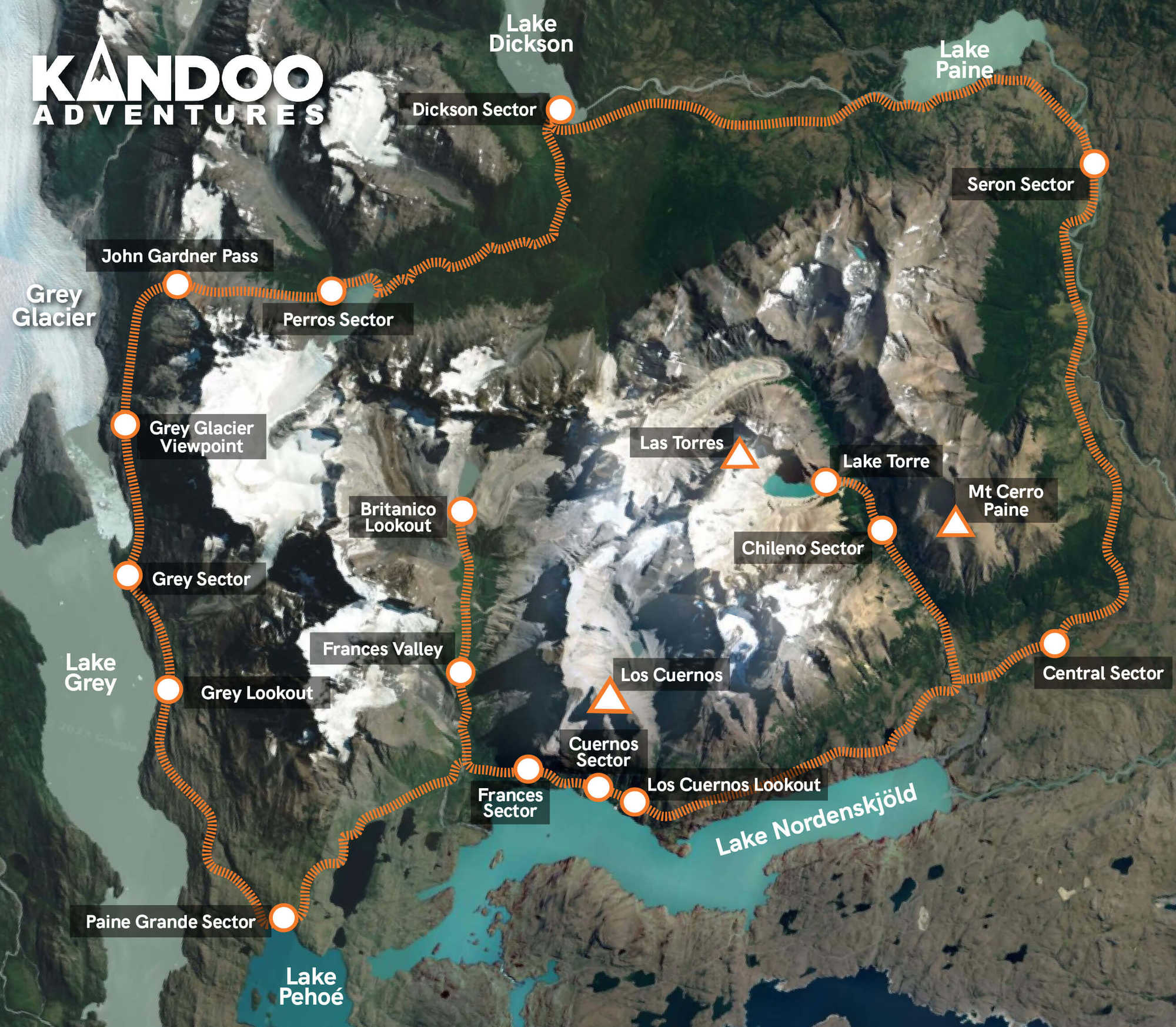 Route map
On the trail
Before you go
Difficulty, food, rooms, kit, money, visas and health, straight from the trip dossier.
Download trip dossierThis adventure is challenging. You will be trekking for 8 days, over some steep and rocky terrain, carrying all your personal equipment and sleeping bag (unless you have chosen to rent this from the campsites). You will be averaging 15km walking per day, the maximum distance covered on a single day being 20km. There may be as much as 1250m of vertical ascent and descent in a day, in particular when crossing the John Gardner pass, the wooded ascent has some boggy sections and root strewn paths that make the going slow before breaking the treeline and being exposed to all the weather can throw at you. The descent isn't any more forgiving; dropping back down through steep woodland paths on the other side. You should therefore be fit and healthy with recent experience of walking in a mountainous environment, over uneven ground for several days in a row. On steep and possibly loose ground, care should be taken to avoid slips and trips, you will definitely find walking poles useful. The weather in Patagonia is notoriously changeable and you should be prepared to walk in strong winds and heavy rain. If you have any questions about your suitability for this trip please feel free to get in touch.
Chilean cuisine consists mainly of meat. You will find grilled meats available everywhere including tripe, intestines and even udders. Meat aside, the cuisine is a mix of Spanish, native American and Italian influences so vegetarians can always fall back on dishes like gnocchi, pasta and pizza. In the large towns and cities, you will find all dietary requirements are catered for. You may also have the opportunity to sample “Mate”, a Paraguayan tea made from a variety of holly and typical drank from a “bombilla”.
In Puerto Natales your hotel is booked on a B&B basis. For your lunch and dinner, you will find a whole host of restaurants serving everything from local cuisine to your home favourites. Patagonia is famous for its BBQs, so grab yourself something off the grill for a true local’s experience.
If you have special dietary requirements please inform us when booking your adventure. We can cater for vegetarian and gluten free diets but refuges usually have set menus and options for these diets can be repetitive. If you have any special dietary requirements, you may want to bring some food items from home to provide a bit of variety. Please be aware that in Torres del Paine, you will need to carry any special food items yourself. On the first half of the trek, you will be in some pretty remote campsites. Getting supplies to these sites is not easy and it isn’t possible to nip out to the shop if you need a particular ingredient. For this reason, it is very important that you tell us about any dietary requirements as early as possible after booking so we can ensure that your diet can be catered for. All meals at the campsites are prepared by campsite staff and you will eat in a dining area at the refuge for breakfasts and evening meals. As there is limited space in the refuges, on your arrival your group will be allocated a meal time. Your guide will share this with you. Packed lunches will be provided each morning for you to take with you in your backpack.
Where the O Circuit meets the W Trek, you can expect a bigger selection of food options which is often served buffet-style.
All campsites have a shop where you can buy a selection of snacks suck as nuts, dried fruit, energy bars, packets of crisps and biscuits as well as soft and often alcoholic drinks.
Whilst trekking, filtered water is available at every campsite for you to fill your bottles or bladder. We recommend you also bring a water filter or purification system to allow you to refill at streams or springs. All drinks, including water, are your own responsibility through out the trip. We don’t recommend the use of plastic bottles which will need to be carried out and recycled.
Whilst in Puerto Natales we will stay in a comfortable 3-star hotel. Rooms will be double or twin with en-suite bathroom. We ensure that the hotel we use is well located to allow you to get out and explore the area.
In Torres del Paine National Park we will be camping. A 2-man tent is provided per two people along with a foam mattress and sleeping bags. Tents will already be set up with mattresses inside...some of them are even raised on special platforms! There will be shared bathrooms with flushing toilets and hot water at all sites. Your meals will be prepared at the campsite and you will eat in the refuge 'restaurant' each morning and evening. All crockery and cutlery is provided. Packed lunches will be provided from the refuge kitchens each morning for you to take with you in your backpack. Tents have space outside of your sleeping quarters where you can store your bags. Some campsites have luggage lockers but these do not have locks. We recommend taking a luggage lock if you use one of the lockers.
Campsites in the most remote parts of this trek are typically pretty basic and sleeping bags may not be laundered after each use. You should bring a good, warm sleeping bag liner. Where the O Circuit meets the W Trek, campsites will be busier and facilities less basic.
Wifi is available at the refuges but is generally of poor quality and speed. Every campsite offers 30 minutes free access and you can pay for more time but, be warned, paying for it does not mean that it will be better quality or faster!
There will be access to electrical sockets at refuges and they are free to use but there are limited sockets for guests to use, the power supply is weak and the sockets can be very busy. We strongly recommend taking a power pack with you and keeping phones in airplane mode to preserve battery life.
Bag Weight: 15kg.
In Torres Del Paine National Park there is no vehicle access and, as we won't be using porters for this trip, you will be carrying all of your own personal equipment, including your sleeping bag liner (from Day 2 to Day 9). For this, you will need a backpack of roughly 40-50 litres to carry with you each day. We recommend that this is no more than 14kg to ensure it is comfortable for you to wear throughout your trek. This can be used as your hand luggage on international and domestic flights. If you wish to bring another bag for items before and after the trek this can be left at the hotel for the trekking period. We recommend bringing a luggage lock as an additional layer of security as storage is in an open area. You should keep all valuables with you whilst you are trekking. Suitcases are fine to bring if you plan to leave them at the hotel.
Note: your backpack for trekking will be for your personal equipment only and will not include tent, mattress or sleeping bag as these will be provided at the sites.
Please also be aware that on domestic flights in Argentina and Chile there is a maximum weight of 15kg on all checked luggage. If your main bag weighs more than 15kg you may be asked to pay excess luggage fees which will be your own responsibility.
You will need a flight that arrives at Teniente Julio Gallardo Airport (PNT) in Puerto Natales on or before Day 1 of your itinerary. To reach Puerto Natales most will people will need to connect through Arturo Merino Benitez International Airport - Santiago (SCL).
To reach Santiago from the UK, British Airways have direct flights departing from Heathrow at 21:55 and arriving at 07:30 the next day (local time). The flight time is 14hrs. Air France offer flights from Manchester with a 2hrs 50min stop in Paris. British Airways have flights from Edinburgh with a stop of 1hrs 4min in Heathrow. Indirect flights have a total travel time of roughly 19 hours to reach Santiago.
For travellers from the USA, LATAM have a direct flight from New York to Santiago departing at 19.30 and arriving the next morning at 05:55 (local time). The flight time is 10hrs 25min. LATAM also offer direct flights from Miami with similar times. Indirect flights are available from Los Angeles, Dallas and San Francisco with LATAM, Delta and Jet Blue.
If you are changing airlines or re-checking your luggage at an airport on route, please ensure you leave a minimum of 3 hours between flights. This will account for any delays on arrival, travel time across airports (this can take longer than you think) and time taken to re-check baggage.
For many people, the journey to Chile is a very long one and you are likely to be pretty tired when you arrive. To give you a better chance of enjoying your trek, we recommend arriving a day early and giving yourself a bit of free time before you start your trek. We can easily book additional hotel nights and arrange transfers for you if you decide to do this.
Travelling Responsibly
Here at Kandoo, we like to support our guests to make their travel more sustainable. As of 2025, we are offsetting the carbon on all of our trips from arrival in destination to dropping you back off at the airport. As we don't include flight travel in our trips these aren't included in our offsetting calculations, so we are providing you with the calculator below for you to do this yourselves.
eC02 Flights Calculator
On your arrival, you will be asked where you are staying that night. This information is on your personal itinerary. We recommend keeping this somewhere safe so you have it to hand when you need it.
United States and UK passport holders do not require a visa to enter Chile. On arrival you will be granted a maximum 90 day stay in the country. On arrival in Chile the immigration authorities will issue you with a 'Tarjeta de Turismo – Tourist Card’ (also known as a PDI). Keep this somewhere safe as you must present this at each campsite.
It is a requirement of joining any of our treks that you attend a pre-trek briefing the evening before the trek begins. This gives our guides the opportunity to speak to you about your adventure, and sort out any last-minute queries or concerns. In Puerto Natales this is held at 6pm on the evening of Day 1 at your pre-trek hotel, your guide will meet you there.
In Chile the currency is the Chilean Peso (CLP).
Few hotels and restaurants will accept US Dollars as a form of currency so it is advisable to travel with Chilean Pesos. Your guide will show you the best places to change currency at the best rate. We do not recommend the use of traveller’s cheques as they are often impractical. Bank cards are widely used for most things but please note that American Express is not commonly accepted.
Please note that if you plan to change money on your arrival, currency exchange offices in Puerto Natales can open at irregular hours or not at all on weekends. If you are travelling through Santiago Airport, you may prefer to exchange money there. Alternatively, the Chilean Peso is not a closed currency and can be purchased before your trip.
In Puerto Natales, an average meal for 2 will be around $40 - $50 and a 5km taxi ride around $8. Taxis are plentiful and most drivers should have a meter, however if they don't, always remember to settle on a price before leaving. If you prefer to do it a bit cheaper then take to the streets, pretty much everywhere in Puerto Natales is less than a 20 minute walk from the town centre.
Our recommended guidance for spending budget per person in Patagonia would be between $100-150 on top of your tips. This will give you ample souvenir spending money.
You should budget for tips for your lead guide and any assistant guides. Tipping is common in Chile but not mandatory and should be based on the level of service you feel you have received, but 50,000 Chilean Pesos (equivalent to £50 - $60) should provide enough for tips for each week on your trip.
The amounts below will give you an indication of how much to tip. Please note that these amounts are for the entire group, not per person, therefore you should divide them by the total number of people in your party.
Lead Guide: 20,000 - 25,000 Pesos ($20-25 / £16-20 per day)
Assistant guide: 7,000 - 8,000 Pesos ($7-8 / £5-6 per day)
As an example: a lead guide may receive $20 per day x 8 days = $160. Divided by 10 people in the group = $16 per person.
If your assistant guide / porters will be leaving you before the end of your trip, they should be tipped after your trek. Your lead guide can be tipped when you return to the hotel.
Tips can be paid in either US$ or local currency.
As soon as possible after booking your tour, please provide Kandoo Adventures with your passport details (first name, last name, date of birth, passport number, issue date, expiry date) along with a photocopy of the photo page.
Your passport must be valid for 6 months after your departure date.
United States and UK passport holders do not require a visa to enter Chile. On arrival you will be granted a maximum 90 day stay in the country. On arrival in Chile the immigration authorities will issue you with a 'Tarjeta de Turismo - Tourist Card'.
This information may be subject to change, without notice, by the local authorities. It is your responsibility to check the latest travel requirements and information before departure.
The World Health Organisation recommend the following vaccinations for travel to Chile:
Diphtheria
Hepatitis A
Hepatitis B
Tetanus
Rabies (for those at high risk)
They also recommend primary course and boosters such as MMR and Flu are up to date.
It is your responsibility to check the latest health information before travelling.
Before you can join any Kandoo Adventures trek, you will need to insure yourself against accident, injury, and illness.
Your insurance must cover the cost of helicopter evacuation and repatriation if necessary. Make sure your insurer knows of your travel plans, and verify that your policy fully covers your trekking and any other activities you will participate in. Specifically, for our adventures in Patagonia, you need to be covered for trekking up to 2000m. It is your responsibility to ensure that you are fully and adequately insured for the duration of your trip. Please ensure that all activities, excursions and destinations in your itinerary are included in your travel insurance policy, in addition to your regular cover for cancellation and medical expenses.
We ask that you keep a copy of your policy summary (containing policy number and the emergency contact number for your insurer) in your day sack at all times, so that we can access this information should we need to contact the insurer on your behalf. You will also need to bring details of your insurance cover to the pre-trek briefing.
Make sure to choose the correct policy for the altitude you are trekking to. Be sure to read the small print carefully for any policy you are considering - different policies provide different levels of cover, so make sure you understand what is and isn't included in your policy.
Malaria
There is no risk of malaria in any of the regions of Chile. However, if you intend to go travelling before or after your tour, please check the specific health risks for the areas you will be visiting.
Dehydration
You will be exerting yourself over numerous days whilst out trekking. This may be something that your body isn’t used to and as a result, you will have to drink much more water than you normally would. You should drink at least 3 litres of fluids every day while trekking. Even when you do not feel thirsty you have to drink this amount as a minimum, preferably more. Stay on the look-out for signs of dehydration in yourself and your fellow trekkers. The most common symptoms include thirst, dry lips, nose or mouth, headache and feeling fatigued or lethargic.
Medication
Your guide carries a first aid kit at all times. However, we recommend bringing any medicine you feel you may need. This could include: -
• Painkillers
• Anti-diarrhoea tablets
• High factor sunscreen for lips and skin
• Moisturising cream (for sunburn)
• Elastic bandage, regular bandages and Blister bandages
• Sanitary products
• Water purifying tablets or filters
• Mosquito repellent
On our Patagonia trips there is a minimum age limit of 15 years old on private trips and 16 years old on open groups. All minors must also be accompanied by a responsible adult. This is a safety requirement put in place by the Torres del Paine National Park.
Whilst trekking and camping we will provide the following:
2 man tent per 2 people
Foam sleeping mattress per person
Sleeping bags
Cutlery, crockery, tables and chairs
Warm hat and gloves
Buff / gaiter
Sunglasses
T-shirts (short and long sleeve)
Thermal long sleeve shirt
Thermal leggings in case of cold nights
2 sweaters - 1 light/1 warm
Soft shell or fleece jacket
Insulated jacket
Waterproof and windproof hard shell jacket
Waterproof and windproof hard shell trousers
Breathable fast drying underwear
Comfortable long trousers (fast drying)
Shorts for trekking in warm weather if desired
Comfy trainers/shoes for evenings
Wool and cotton socks
Hiking boots (with ankle support and a slightly ridged sole)
Flip-flops / sandals (for use in showers at campsites)
Microspikes (optional but may be useful if there has been snow on higher passes - you may prefer to rent these in Puerto Natales)
Warm sleeping bag liner - this will be carried in your backpack
2 water bottles (minimum 1 litre or a water bladder)
Walking poles (recommended)
Head torch with spare batteries and bulb
1 duffel bag - for personal items prior to or after trek (flexible and water resistant)
1 rucksack - 50-70 litres to carry with you each day
Water purification system (charcoal filter, chlorine tablets or similar)
Quick drying towel
Dry bags – for packing your kit into if your bag is not waterproof
Toiletries
A container for any toxic rubbish (batteries, sanitary products etc.)
Luggage locks
Trekking poles and other trekking items are available to rent from our team in Torres del Paine. These should be pre-booked and will be ready for you when you start your trip. If you are planning on renting multiple items for your trek, there are numerous rental stores in Puerto Natales that stay open in the evenings. Some have an online reservation service so you can make all arrangements before your trip and collect the items when you arrive. Please let us know if you require further information.
More like this
 Kilimanjaro
Summits
Kilimanjaro Northern Circuit
 Guyana
Multi-activity · Trekking
Kanuku Mountains Adventure
 Argentina
Trekking
Peaks of Patagonia
 Peru
Trekking
The Inca Trail
 ChileSale
Trekking
The W Trek
 NepalSale
Trekking
Gokyo Lakes Trek